

By Debbie Neese, Horticulture Certification | 16 years in the green industry | Founder, Offshoot Virtual Landscape Services (est. 2012)
Journey worker vs. registered apprentice comes down to registration. A registered apprentice holds an individual registration in a program approved by the U.S. Department of Labor or a state agency like ApprenticeshipNC. Everyone else gets the full wage rate for their classification and goes down as a J on your WH-347.
Not Sure Who Gets a J and Who Gets an RA on Your WH-347?
You’re staring at the payroll form, and Column 2 wants a letter. Your crew has a lead with twenty years on a skid steer, a new hire who started Monday, and a helper who is “kind of” in a training program.
So which letter goes where? Guess wrong, and you may owe back wages on a job you already finished. Get it right, and payroll stays quick.
Good news: the rule is simpler than it looks. This guide breaks down journey worker vs. registered apprentice with a plain test for each employee. It also shows you how to fill in the label on your WH-347 the same way every week.
Journey Worker vs Registered Apprentice: What Is the Real Difference?
A journey worker is a fully skilled worker who gets the full wage rate for the work they do. The Department of Labor spells it “journeyworker” as one word, and you’ll see that on the WH-347 instructions. It means the same thing.
A registered apprentice is different. This person trains in a formal program. The U.S. Department of Labor’s Office of Apprenticeship, or a state agency it recognizes, approves that program. In North Carolina, that agency is ApprenticeshipNC.
Here is the part that trips people up. Your shop’s job titles don’t decide the label. Registration does.
In practice, every worker who isn’t a registered apprentice gets the full rate and is classified as a J. Rules can vary by contract, so read your wage determination and ask your prime or agency if something is unclear.
| What to check | Journey worker (J) | Registered apprentice (RA) |
|---|---|---|
| Who counts | Anyone paid the full rate | Worker registered in an approved program |
| Proof needed | Classification from the wage determination | Program approval plus individual registration |
| Pay rate | Full wage determination rate | Program’s percentage of the full rate |
| Fringe benefits | Full wage determination fringes | Set by the program, or full fringes if it’s silent |
| WH-347 Column 2 | J | RA, plus the progression level |
| Extra WH-347 step | None | Box 4: program and agency |
| Ratio limits | Counts toward the ratio | Capped by the ratio, checked daily |
How Do You Decide if an Employee Is a Journey Worker or a Registered Apprentice?
Run every employee through the same five questions. Do it before their first payroll, and again whenever their situation changes.
- Is this person individually registered? Ask for the paperwork that proves it. A verbal “I’m in a program” doesn’t count. If you’re unsure, ask the program sponsor or ApprenticeshipNC to confirm.
- Is the program itself approved? It must hold registration with the Office of Apprenticeship or a recognized state agency. If that agency withdraws approval, you can’t pay apprentice rates until an approved program is reinstated.
- Is this person in a certified 90-day probation? You can pay a worker who isn’t registered yet as an apprentice for the first 90 days. However, the Office of Apprenticeship or the state agency must first certify that person as eligible for probationary employment.
- What work will this person actually do? Find the classification on your wage determination that corresponds to the work, not the job title. A worker who spends the day on equipment gets the equipment classification, whatever your crew calls them.
- Does the ratio work today? Every registered program sets a limit on apprentices per journey worker. On any day you go over that limit, the extra apprentices get the full wage rate.
What Do Your Answers Mean?
If the worker holds a registration in an approved program or is in certified probation, mark them RA. Everyone else is a J. You pay J workers the full wage rate for the classification they work.
Callout: “Pre-apprentice” isn’t a category under Davis-Bacon. If the person isn’t registered, pay the full rate for the work they perform.
The ratio comes from your registered program, or from the job’s location when the two differ. If the job sits outside your program’s home area, follow the ratio and wage rates for the job’s location. Reviewers check the ratio daily, not weekly.
What Happens if You Pay an Apprentice Rate to Someone Who Isn’t Registered?
You owe the difference. Any worker paid at an apprentice rate without registration must get the full wage determination rate for the work performed. You also owe interest on the underpayment, and the agency can hold back payments until you fix it.
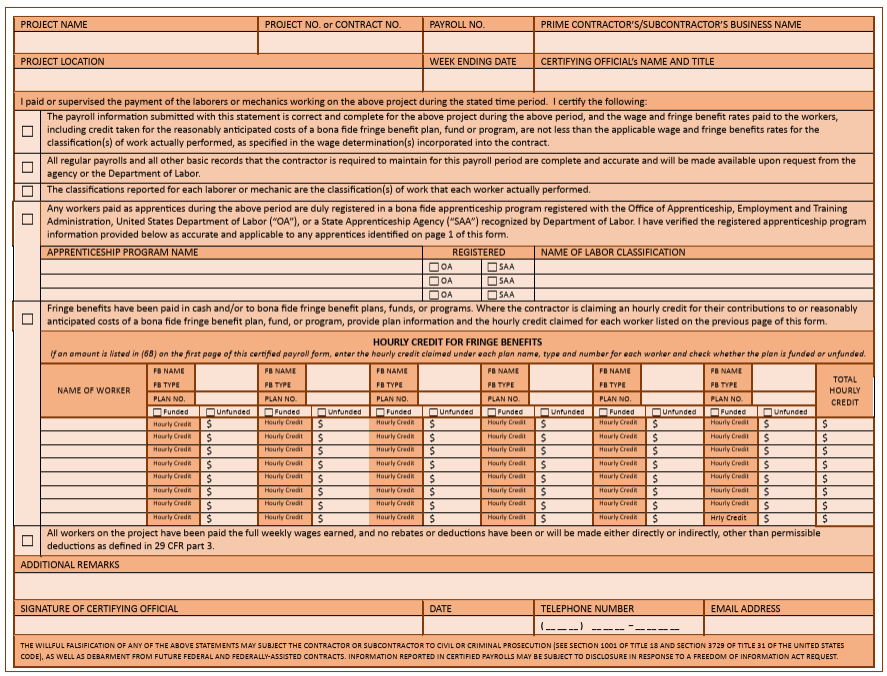
Warning: The Statement of Compliance you sign says every worker got the right rate. Falsifying it can bring civil or criminal penalties, so accuracy matters more than speed here.
From our own files: When we set up certified payroll for a new subcontractor, we start with the crew list. We ask one question about every name: Can you show me the apprenticeship registration? If the answer is no, that worker goes on the payroll at the full wage determination rate. The check takes two minutes, and it prevents most of the cleanup we see later.
How Do You Label Each Worker on the WH-347?
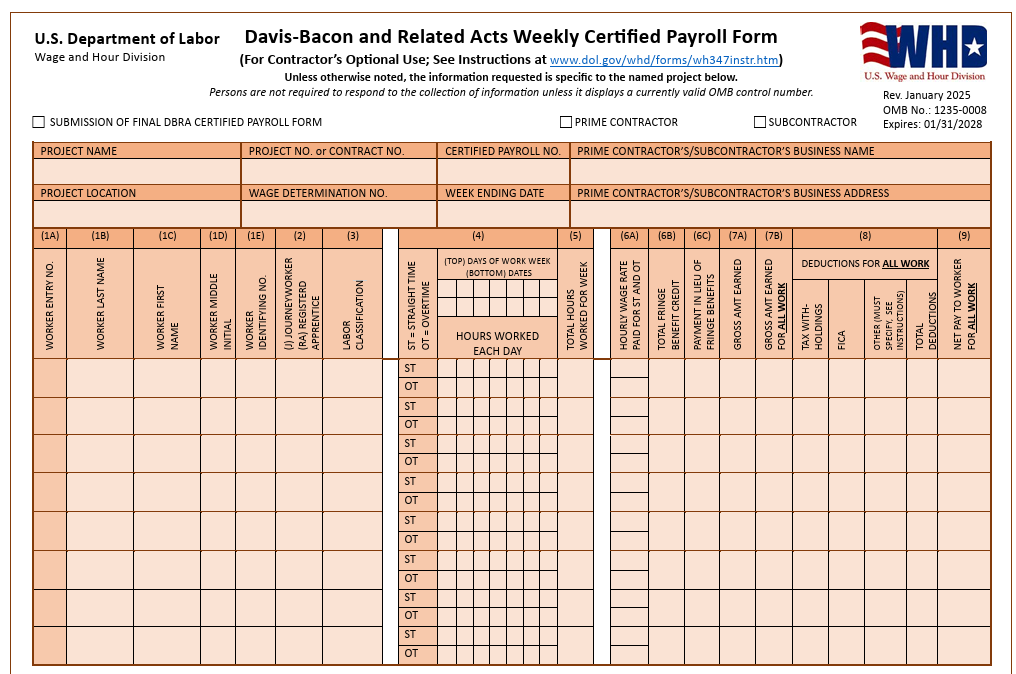
Think of the label as three pieces: a letter, a classification, and a little extra detail for apprentices. Each piece lives in a different spot on the form.
Callout: Column 2 answers “who is this person?” Column 3 answers “what work did they do?” Keep those two questions separate, and the form gets easier.
Column 2: Do You Enter J or RA?
Enter J for a journey worker and RA for a registered apprentice. For every RA, also list their level of progression within the approved program. Your program’s wage schedule tells you that level. The Department of Labor’s WH-347 instructions explain this.
Column 3: Which Classification Do You List?
List the classification for the work the person actually performed, and copy the wording from your wage determination. Your own job titles don’t belong here.
If someone works in two classifications in one week, use one line for each. Use the same entry number on both lines, and keep hours for each classification in your records.
Suppose no classification fits the work. You can’t make one up. The contracting officer must approve a new one first, through a conformance request (SF-1444).
Box 4: What Extra Step Do Apprentices Need?
If you pay anyone as an apprentice that week, check Box 4. Next, list each program name and mark whether it’s registered with the Office of Apprenticeship or a state agency. Add the classification the apprentice worked. Skip the box if no one on your payroll is an apprentice.
What Does the Label Look Like in Real Life?
| Worker | Column 2 | Column 3 | Pay |
|---|---|---|---|
| Crew lead, 20 years’ experience, no apprenticeship | J | Classification for the work performed | Full rate |
| New hire registered in an approved program | RA, plus progression level | Classification for the work performed | Program’s percentage of the full rate |
| New hire “in training” but not registered | J | Classification for the work performed | Full rate |
| Worker in two classifications in one week | Same letter on both lines | One line per classification | Rate for each classification |
What Paperwork Should You Keep for Apprentices?
Keep written proof for every apprentice you pay at the lower rate. The rules require three things:
- Proof that the program is registered
- Your apprentice’s registration record
- The ratios and wage rates in that program
Store these with your payroll records. Keep them for at least 3 years after you finish all the work on the prime contract. Reviewers can also ask to see them, and they can interview your crew on the job.
On NCDOT work, this fits into the same file system as your subcontract paperwork. Our guides to DOT subcontract administration and the DOT project file system show how to set that up. If you’re new to the whole process, start with what certified payroll is.
What Is a Simple Weekly Routine for Classifying Your Crew?
Use this checklist before you sign each payroll.
- List every worker who touched the job site this week.
- Match each person’s work to a classification on your wage determination.
- Confirm each apprentice’s registration is on file and the program is still approved.
- Count apprentices and journey workers for each day, not just the week.
- Enter J or RA in Column 2, and add the progression level for each RA.
- Record the classification in Column 3, using one line per classification.
- Check Box 4 if any apprentice worked, then enter the program and agency.
- Sign the Statement of Compliance only when every line checks out.
Keep my free downloadable Certified Payroll Worker Tracker handy so you, your office, and your payroll helper all work from the same crew roster. Our WH-347 fillable form guide can help you choose a filing method.
Journey Worker vs Registered Apprentice: Frequently Asked Questions
What is a journey worker on certified payroll?
A journey worker is a fully skilled worker paid the full wage rate for their classification. On the WH-347, you enter J in Column 2.
What does registered apprentice mean on a WH-347?
It means the worker holds an individual registration in a program approved by the Office of Apprenticeship or a state agency. You enter RA in Column 2 and list the program in Box 4.
Is a journeyman the same as a journey worker?
Yes. Journeyman is the older term, and the Department of Labor’s rules use journeyworker. Both describe a fully skilled worker, and neither one is the same as an apprentice.
Does more experience make someone a journey worker?
Not by itself. If the worker isn’t a registered apprentice, you pay the full rate and enter J, no matter how long they’ve been on your crew.
Can I pay a new hire the apprentice rate while they finish registering?
Only during the first 90 days, and only if the Office of Apprenticeship or the state agency has certified them for probationary employment. Otherwise, pay the full rate.
How many apprentices can I use on one job?
That depends on the ratio in your registered program, or the ratio for the job’s location. Check it every day, because you must pay apprentices over the limit the full rate.
Where do I confirm a program is registered in North Carolina?
Contact ApprenticeshipNC, the state agency recognized by the U.S. Department of Labor. If your program is federally registered, the Office of Apprenticeship can confirm it.
How long do I keep apprentice records?
Keep them for at least 3 years after all the work on the prime contract is complete. Store them with your certified payrolls.
Is a registered apprenticeship worth it for a small landscape company?
It can be, if you plan to hire and train workers over time. The program lets you pay apprentice rates on covered jobs, but it also brings registration, ratios, and training duties. ApprenticeshipNC can walk you through the steps and point you to possible funding.
Ready to Take Payroll Labels Off Your Plate?
You’ve got crews to run and jobs to bid. Offshoot prepares weekly certified payrolls for green industry contractors, including NCDOT subcontractors, so J and RA never keep you up at night.
Call us at 828-699-8022, or book a free 30-minute consultation with Offshoot Virtual Landscape Services. Want to see the big picture first? Read our guide to certified payroll for landscapers.
I’m an offshoot of your business.
About the Author
Debbie Neese is the founder of Offshoot Virtual Landscape Services, LLC, a virtual assistant and back-office firm serving landscapers, hydroseeders, lawn care companies, and tree services across the U.S. She started in the green industry in 2010, studying horticulture and working at a nursery, and founded Offshoot in 2012. She holds a Horticulture Certification and an Associate of Science in Business Administration. Her gardening expertise has appeared in Martha Stewart, Southern Living, The Spruce, Well+Good, and Family Handyman.


