
What Is Certified Payroll? A Contractor’s Guide
Certified payroll is a weekly wage report you file on government-funded construction work. It lists every worker, their hours, their job classification, and their pay. Then you sign a Statement of Compliance certifying the numbers are true and send it up the chain.
That’s the 40-word answer. Now here’s the part nobody puts in the contract packet.
If you’re searching for what certified payroll is at 9 p.m. with a truck full of time sheets, you’re in good company. Plenty of contractors win their first government job, do beautiful work, and then watch the checks stall. Nobody warned them the office side would be the hard part.
Let’s fix that.
The short version of what is certified payroll: a report for every single week your crew works on a covered site — even a week with one half-day of work.
What Is Certified Payroll, Exactly?
Think of it as a receipt for your labor. The government pays for the project, so it wants proof that the people who built it earned the local prevailing wage.
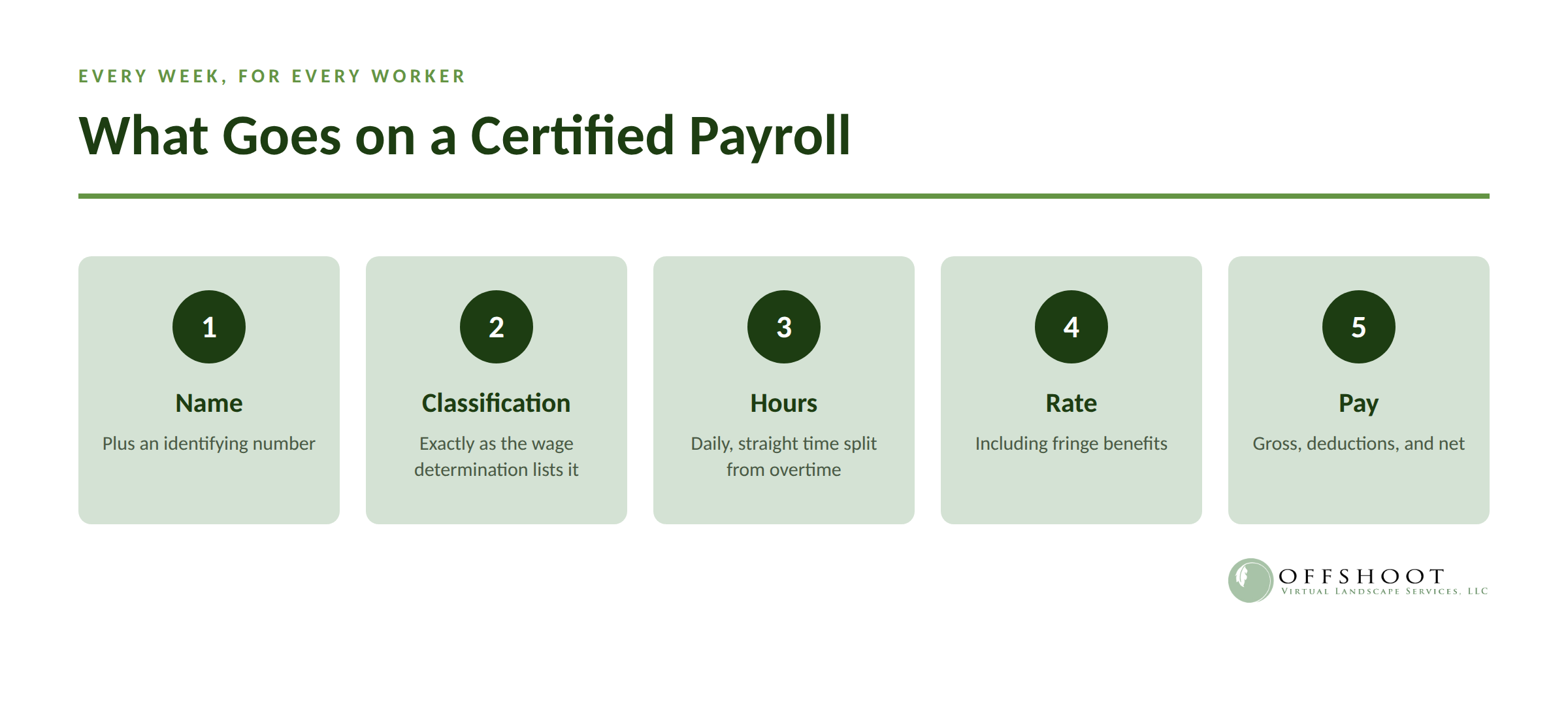
A certified payroll report shows:
- Each worker’s name and an identifying number
- The work classification — laborer, equipment operator, truck driver, and so on
- Daily hours, split between straight time and overtime
- The hourly rate paid, including fringe benefits
- Gross pay, deductions, and net pay
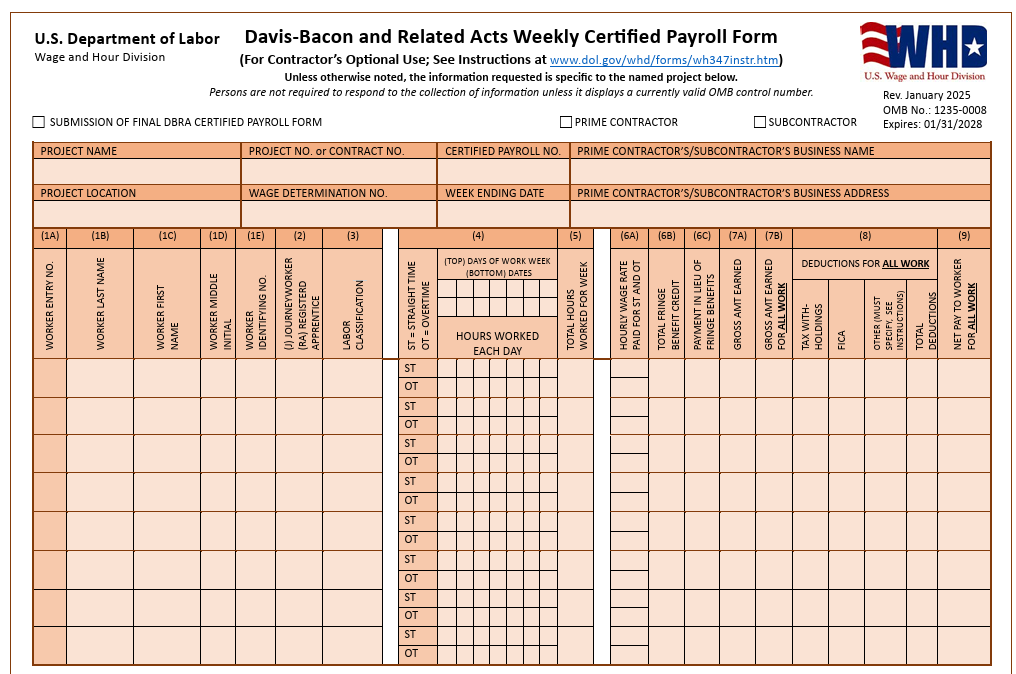
Most contractors file this on Form WH-347, the U.S. Department of Labor’s weekly payroll form. However, the form itself is optional. The information on it is not, so nearly every prime asks for the WH-347 layout anyway.
What Makes It “Certified”?
Page two. That’s the whole answer.
The second page holds the Statement of Compliance, a short paragraph you sign every week. By signing, you certify three things: your records are accurate, you paid everyone their full wages, and you paid at least the required rate for the work actually performed.
That signature carries real weight, because it’s a federal certification. In fact, a false statement can bring fines and up to five years in prison. So an unsigned payroll isn’t a late payroll — it’s just paper.
Who Has to File Certified Payroll?
Most contractors ask what certified payroll is before they ask who files it. Fair enough, because the two answers connect.
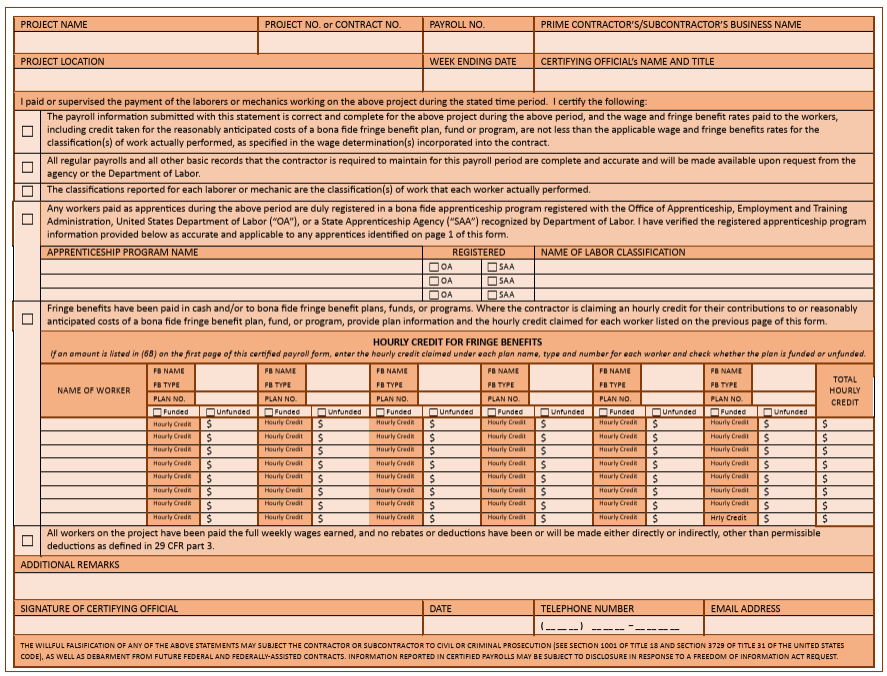
Short answer: anyone whose crew performs construction work on a federally funded project. That covers prime contractors and every subcontractor under them.
The $2,000 Rule That Surprises Subcontractors
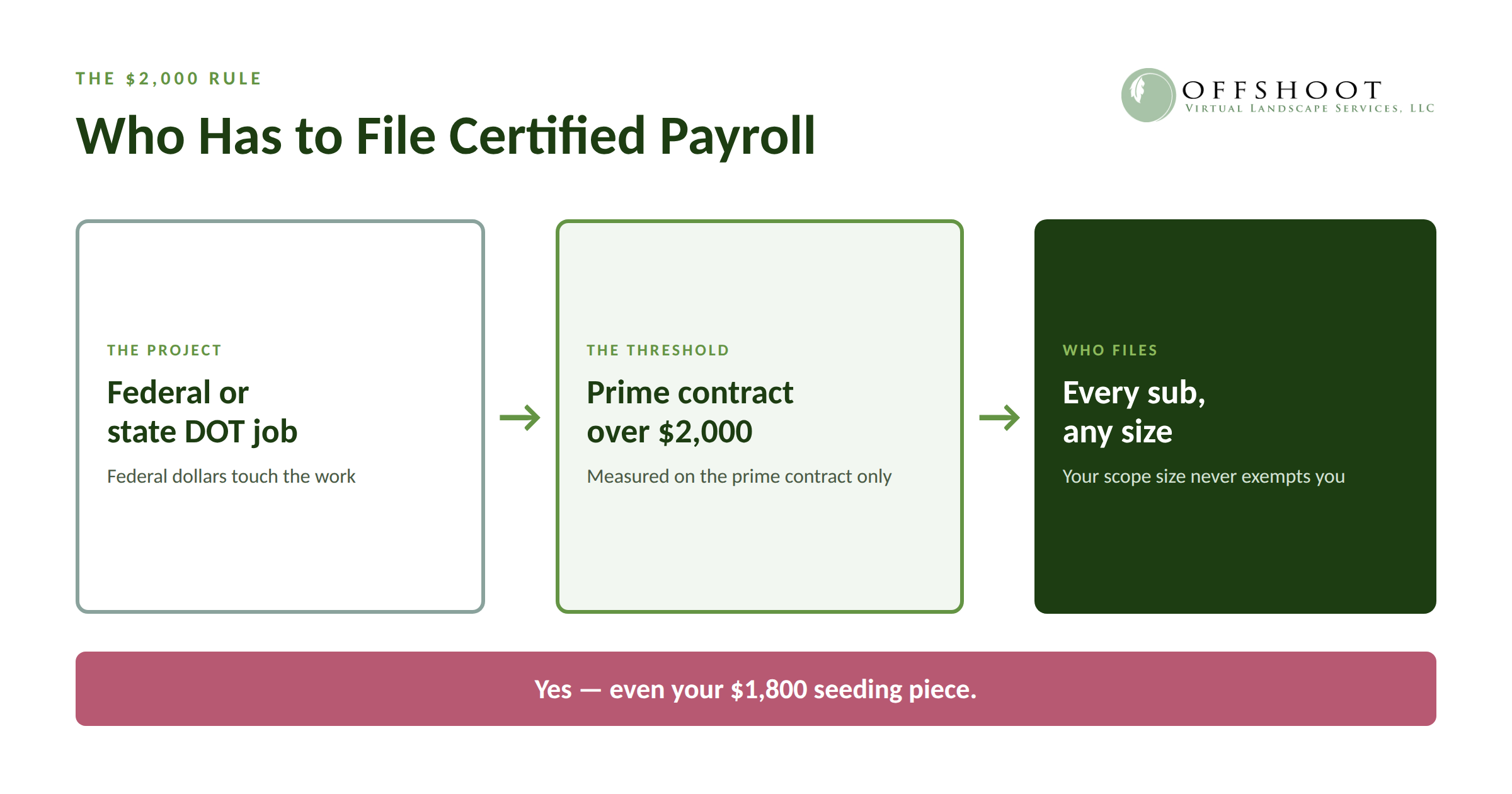
The Davis-Bacon Act — the 1931 law behind all of this — applies to federal contracts over $2,000 for construction, alteration, or repair. Contractors hear “$2,000” and assume their small piece of the job slides underneath it.
Unfortunately, it doesn’t work that way. The threshold applies to the prime contract only. So if the prime contract clears $2,000, every subcontractor is covered, no matter how small their scope.
A $1,800 seeding sub on a $4 million highway job files certified payroll just like everyone else.
State DOT Jobs and the Federal Dollar Test
Here’s the test that settles most questions: follow the money. If federal dollars touch the project, prevailing wage rules usually follow them onto the site — including federal-aid highway work you perform for your state DOT.
State law adds a second layer. About half the states run their own prevailing wage law with its own reporting rules. North Carolina doesn’t have one, so NCDOT work triggers certified payroll when federal funding sits in the project.
Heads up: Seeding, sodding, hydroseeding, erosion control, matting, and slope repair all count as covered construction work when your crew performs it on site. Landscaping isn’t a side dish on a highway job — it’s construction.
Weekly Filing: The Rhythm Nobody Warns You About
Certified payroll runs on a weekly clock, and that clock doesn’t care how busy spring gets. You file one report for every week your crew touches the site.
The deadline catches people off guard. Federal rules give you seven days after your regular pay date to submit that week’s payroll. Miss it, and you’re late — even when the fieldwork was flawless.
Don’t Skip the Empty Weeks
Rained out? Crew pulled to a private job? You may still owe a “no work performed” statement, because most primes need an unbroken numbering sequence.
Then there’s the filing path itself. Some primes want a PDF by email, while others require an upload into a compliance portal. Therefore, ask your prime and the resident engineer for the format before your first payroll comes due, not after the third one runs late.
Keep the Records for Three Years
Filing isn’t the end. You also have to preserve payroll records and supporting documents for at least three years after all work on the prime contract wraps up.
Store them digitally if you can, since auditors and primes both ask for old weeks at inconvenient times.
What Happens When You Get Certified Payroll Wrong
Nobody mails a warning letter first. Instead, the consequences show up quietly in your bank account.
First, They Hold Your Money
Most primes withhold payment until your certified payrolls are current, because their own money from the agency depends on a complete compliance file. Your scope of work finished in April. Meanwhile, the invoice sits in a folder because week 12 is missing a signature.
The prime isn’t punishing you. They simply can’t submit an incomplete file, since the agency won’t accept it.
Then it compounds. One missing week becomes six, and six becomes a season. As a result, you finance a government project out of your own pocket while payroll for your own team gets tight.
Then It Gets Expensive
Agencies can withhold contract funds to cover back wages they believe workers are owed. Under the 2023 Davis-Bacon rule update, they can also cross-withhold — pulling money from a different contract held by the same prime.
The far end of that road is debarment. Contractors who disregard their obligations to workers can lose the right to bid federal work for three years, and that period now applies across Davis-Bacon and the Related Acts alike.
“Late certified payroll isn’t a paperwork problem. It’s a cash flow problem.”
How to Stay Current Without Losing Your Mondays
Good news: this gets easy once a system carries it. You have three honest options, so pick the one that fits your week.
- Do it yourself. Block 60 to 90 minutes every Monday morning. Then build a simple tracking workbook, and never let a week pass unfiled. Here are directions on WH-347 Form: How to Fill It Out LIne by LIne that should help with this chore.
- Train someone in the office. This fits well if you already have an administrator who likes detail. However, they need real training on wage determinations, not just the form.
- Hand it off. That’s where we come in.
What Working With Offshoot Looks Like
At Offshoot, our certified payroll services are filed week after week for landscape and hydroseeding contractors on government work. First, we clean up any backlog, so your unpaid invoices start moving. Next, we build field documentation SOPs, so crews record the day’s work on site instead of in a shoebox. Then we file every week, on schedule, for as long as the contract runs.
One contractor came to us six to eight months behind. His work was finished; the money was not. Because the compliance file finally went in complete, the invoices moved.
Want the mechanics of the form itself? Our guide to certified payroll for landscapers walks through WH-347 line by line too.
📋 Free download — the Certified Payroll Starter Checklist. One page, everything you need to gather before you fill in a single number. Get the checklist.
Certified Payroll FAQ
The Basics: What It Is and Who Files It
Q: What is certified payroll in simple terms? A: It’s a weekly report showing who worked on a government-funded job, what they did, how many hours they put in, and what you paid them. You sign a Statement of Compliance swearing the information is accurate. Most contractors file it on Form WH-347.
Q: Do I need certified payroll for a small subcontract? A: Yes, in almost every case. The $2,000 Davis-Bacon threshold applies to the prime contract, not to your piece of it, so subcontractors of any size are covered.
Q: What is certified payroll on an NCDOT or state DOT job? A: It’s the same weekly federal report, submitted to your prime contractor rather than directly to the agency. North Carolina has no state prevailing wage law, so the requirement comes from the federal funding on the project.
Time, Cost, and What Late Really Costs You
Q: How long does a weekly certified payroll take to complete? A: With clean time records and the wage determination in front of you, one crew’s weekly payroll takes roughly 20 to 45 minutes. Missing signatures and guessed classifications are what stretch it into hours.
Q: How much does it cost to outsource certified payroll? A: Pricing generally depends on crew size, the number of active contracts, and whether you need backlog cleanup first. Most contractors find the monthly cost lands well below what a single delayed invoice costs them in cash flow.
Q: What happens if my certified payroll is late? A: Your prime can withhold payment until the file is current. Repeated problems can escalate to back-wage findings, withheld contract funds, or debarment from federal work for three years.
Q: Is government work worth the paperwork for a small contractor? A: For most crews, yes. Public projects pay reliably and repeat season after season, so the reporting is really an entry fee — and it stops feeling heavy once a system handles it.
Let’s Take the Stack Off Your Desk
You came here asking what is certified payroll. Now you know it’s a weekly habit, not a mystery — and habits are the easiest thing in the world to hand to someone else.
You didn’t start a contracting business to become a compliance clerk. So let’s get those reports off your kitchen table and back on schedule.
Book a free 30-minute consultation, and we’ll look at exactly where you stand. Call 828-699-8022 or visit virtuallandscapeservices.com to grab a time. Bring your questions and your worst pile of paperwork, because we’ve seen worse and we’ve fixed worse.
You handle the site work. We’ll handle the certified payroll.
I’m an offshoot of your business.
Helpful links: Form WH-347 and instructions from the U.S. Department of Labor · State prevailing wage laws by state (DOL) · Offshoot back-office services · Book a free consultation


