

By Debbie Neese, Horticulture Certification | 16 years in the green industry | Founder, Offshoot Virtual Landscape Services (est. 2012)
To fill out WH-347, start with your company and project details in the header. Then list each worker with their classification, daily hours, pay rate, gross earnings, deductions, and net pay. Sign the Statement of Compliance on page two. File the form weekly, within seven days of your regular pay date.
You Can Read a Slope. This Form Reads Like a Tax Return.
You won the bid. The slope work, the seeding, the erosion control, all of it is yours. Then the prime contractor emails and asks for your certified payroll.
Welcome to the part nobody warned you about.
That’s fair, by the way. Nobody taught Davis-Bacon compliance in horticulture class. So the form sits on your desk while you try to figure out what a wage determination is and why anyone needs your workers’ hours broken out by day.
Meanwhile, the invoice you earned in April sits unpaid. Your work was finished weeks ago. The paperwork wasn’t.
Here’s the good news. Knowing how to fill out WH-347 takes an hour to learn, not a semester. Let’s walk through it, starting with week one.
What Is Form WH-347, and Why Does Your Prime Want It?
Form WH-347 is the U.S. Department of Labor’s weekly certified payroll report. It shows who worked, what they did, how many hours they logged, and what you paid them. Then you sign a Statement of Compliance swearing the information is true.
The form itself is optional. However, the information is required, and most primes want this exact layout anyway. So start here.
The prime submits a complete compliance file before the state releases money. Because your payrolls sit inside that file, one missing week stalls payment for everyone underneath you.
Callout: Your certified payroll isn’t busywork. It’s the key that unlocks your invoice. So a missing week isn’t an admin problem, it’s a cash flow problem.
If the whole system is new to you, start with our guide to what certified payroll is and how it works. This post assumes you already know you need to file, and just need to know how.
Why Does a Landscape Crew End Up on a Federal Form?
The Davis-Bacon Act sets prevailing wage rules on federal construction contracts over $2,000. Related laws extend those rules to federal-aid highway work, which is how most state DOT projects land in the same bucket. Therefore, if federal dollars touch the job, prevailing wage usually follows them onto the site.
Here’s the part that surprises people. Seeding, sodding, hydroseeding, erosion control, matting, and slope repair all count as covered construction work. Your crew isn’t doing landscaping alongside a highway project. In the wage determination’s eyes, they’re doing construction.
That surprise is where most first-year backlogs start. Owners assume the landscape scope is exempt, skip the first few weeks, and then face a stack of missing payrolls in July. For more on how the whole subcontract fits together, see our guide to DOT subcontract administration.
What Do I Need Before I Fill Out WH-347?
Chasing paperwork mid-form turns 20 minutes into two hours. So collect four things first:
- The wage determination for your contract, which lists pay rates by job classification
- Daily time records showing hours by worker and by day
- Payroll records with gross pay, every deduction, and net pay
- Contract and project details from your prime, including the contract number
Ask your prime for the wage determination before the crew’s first day, not after your first payroll comes due. Then post it at the job site, because covered projects generally require it.
Callout: Grab our free certified payroll starter checklist. It covers the four documents above, five things to confirm before you sign, and three dates you can’t miss. Print it and pin it by the printer.
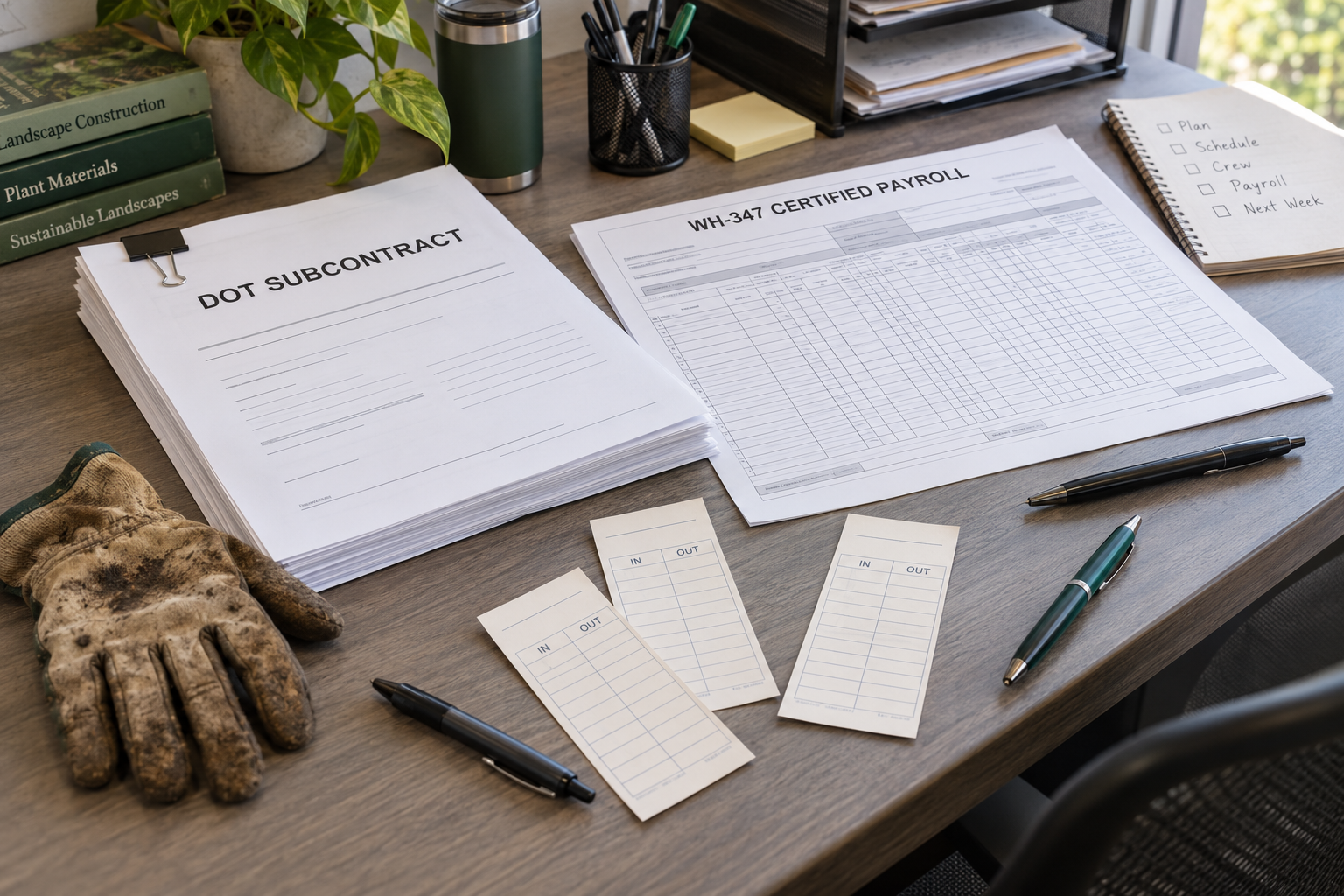
How Do I Fill Out WH-347, Line by Line?
Filling out WH-347 comes down to working across the form in order. Do that, and the numbers take care of themselves. The official Form WH-347 and instructions from the U.S. Department of Labor are free to download, so pull one up and follow along.
Step 1: The Header
Start at the top of page one. Enter your company name and address, then check the box to mark yourself as a subcontractor. Next is the payroll number, which starts at 1 for your first week and increases by one each week after.
Then enter the week-ending date, project name and location, and the contract or project number. Get that numbering right from the start. Otherwise you’ll spend an afternoon renumbering a season’s worth of forms.
Step 2: Columns 1 Through 3
Column 1 takes each worker’s name and an individual identifying number. Most contractors use the last four digits of the Social Security number, since full numbers don’t belong on a submitted form.
Next, Column 2 asks for withholding exemptions. Many primes no longer require it, so ask before you fill anything in.
Column 3 is the trickiest of the three. Enter the work classification exactly as it appears on your wage determination, such as Laborer, Operator, or Truck Driver. Invented job titles get payrolls rejected.
Step 3: Columns 4 and 5
Column 4 is a grid. Write the day and date across the top, then record hours worked each day on the line to the right. Use separate rows for straight time and overtime; never blend them.
Put weekly totals in Column 5. Add straight time and overtime separately, then check the math against your time sheets. A crew leader who ran the skid steer on Tuesday needs those hours split across two classifications.
Step 4: Columns 6 Through 9
Column 6 holds the pay rate, including fringe benefits. Enter weekly gross earnings in Column 7. If a worker split the week between this job and private work, show the project gross over the total gross.
Next, Column 8 breaks out deductions, including FICA, withholding tax, and anything else, with a total at the end. Net wages actually paid land in Column 9. Those figures must match the checks you wrote.
Step 5: Page Two, the Statement of Compliance
Page two turns the form into a legal statement. Fill in the date, your name and title, your company name, and the payroll period covered.
Then choose how you pay fringe benefits. Box 4(a) covers fringes paid into approved plans or funds, while box 4(b) covers fringes paid in cash directly to workers. Use box 4(c) for exceptions and notes, such as an apprentice rate or a deduction that needs explaining.
Finally, sign it. Without that signature, the whole payroll is just paper.
What Mistakes Get Certified Payrolls Rejected?
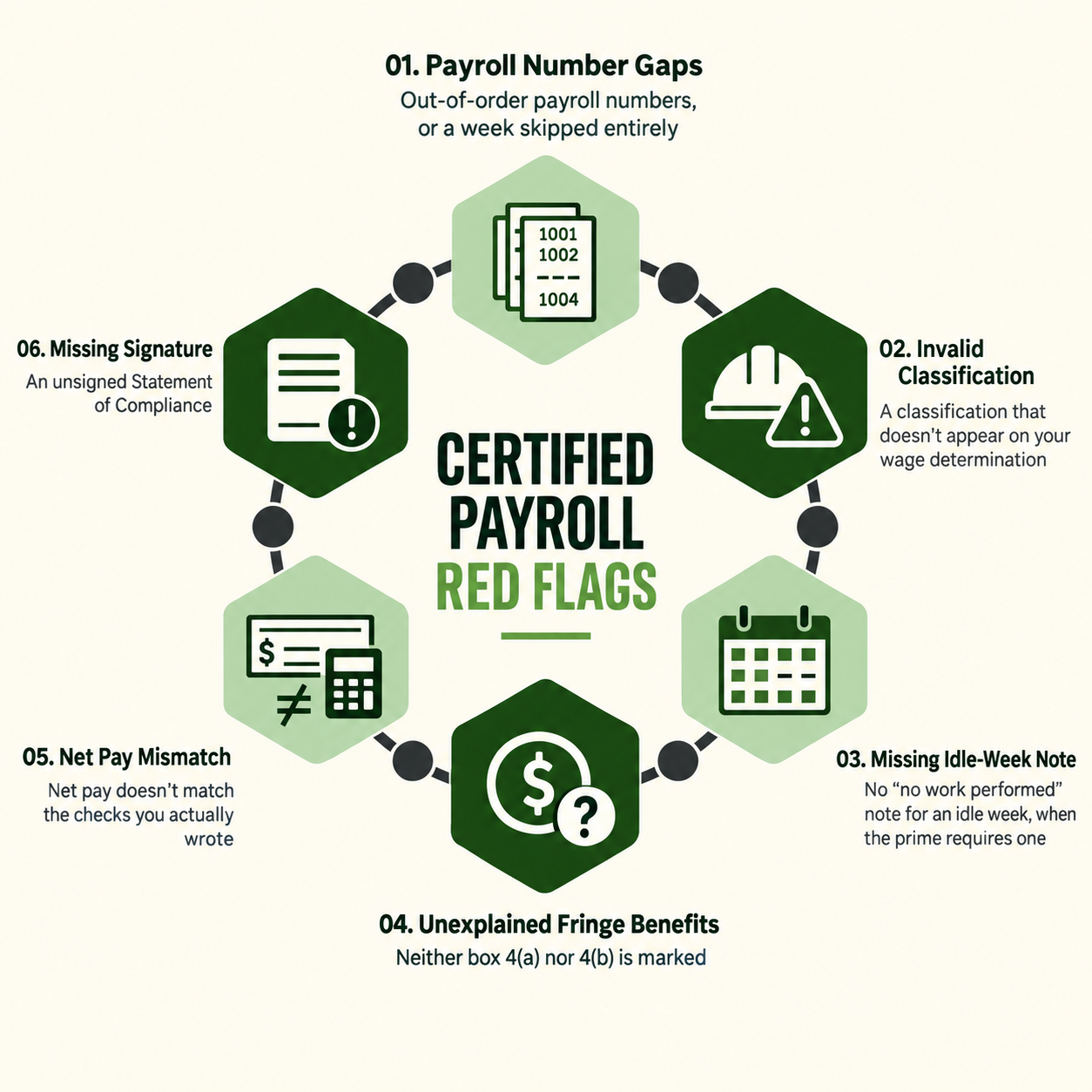
Contractors who fill out WH-347 correctly still get payrolls kicked back, usually for the same few reasons. For example, a crew leader gets classified as a laborer for a day of operating. Similarly, fringe benefits disappear into the base rate with no explanation.
Watch these six:
- Out-of-order payroll numbers, or a week skipped entirely
- A classification that doesn’t appear on your wage determination
- No “no work performed” note for an idle week, when the prime requires one
- Unexplained fringe benefits, with neither box 4(a) nor 4(b) marked
- Net pay that doesn’t match the checks you actually wrote
- An unsigned Statement of Compliance
Warning: Late payrolls don’t just delay your check. They can also trigger withholding, back-wage findings, and in serious cases a contract default. So fix small gaps fast, while they’re still small.
Made an error on a form you already sent? File a corrected payroll for that week and label it as a correction. Because you signed the original under a compliance statement, fixing it quickly matters more than getting it perfect the first time.
Where Does the Form Go, and When Is It Due?
Once you fill out WH-347, you don’t send it to the government directly. As a subcontractor, you send certified payroll to the prime contractor. Then the prime bundles it with everyone else’s and submits the file to the state DOT.
Your deadline runs tighter than most people expect. Federal rules require weekly payrolls within seven days after the regular pay date. So a Friday pay date means the form is due the following Friday.
Submission methods vary widely. Some primes want a PDF by email, while others require an upload into a compliance portal such as LCPtracker or B2GNow. Therefore, ask which system they use before your first payroll comes due, not after the third one runs late.
What About Weeks When Nobody Worked?
Many primes want a “no work performed” statement for weeks your crew stayed off-site. It keeps the payroll numbering sequence intact.
Ask yours, because a gap in the sequence looks exactly like a missing payroll. Then file that note the same way you’d file a regular week.
Should You File It Yourself, Train Someone, or Hand It Off?
There’s no single right answer. Still, it helps to see the options side by side.
| Do It Yourself | Train Your Office Admin | Landscape Virtual Assistant | |
| Cost | Your time | Salary plus training | Hourly or package pricing |
| Your time each week | 30 to 90 minutes | Low, after training | None |
| Knows wage determinations | You learn it | Needs real training | Yes |
| Knows the green industry | Yes | Varies | Yes |
| Handles backlog cleanup | You do | Rarely | Yes |
| Covers your busy season | No | Only if they stay | Yes |
| Also helps with other office work | No | Yes | Yes |
| Best for | One crew, one contract | Growing offices with a detail person | Owners who want it right without learning it |
Learning how to fill out WH-347 is one thing. Doing it 40 weeks straight, in season, is another. So if you have Monday mornings free and you like detail work, DIY absolutely works. On the other hand, if the second contract just landed and the weeks are piling up, hand it off.
What Offshoot Takes Off Your Plate
You didn’t start a landscape business to become a compliance clerk. Slopes that hold and lawns that come in thick- that’s the work you signed up for.
That’s exactly where Offshoot Virtual Landscape Services steps in. We work as an extension of your office, and because we know the trade, you won’t have to explain what hydroseeding is or why spring buries you.
Here’s what we handle on the certified payroll side:
- Wage determination review and worker classification setup
- Weekly WH-347 preparation and filing, every week the contract runs
- Backlog cleanup, including reconstructing missing weeks from your records
- Field SOPs so crews document and sign work on site, not from memory
- Prime contractor and portal submission, in whatever format they require
- Record retention, organized so an audit request takes minutes
- Change order, retainage, and lien waiver tracking alongside the payroll
You can see the full scope in our remote admin packages for lawn and landscape companies and create a custom package for your needs.
From our own files: A hydroseeding and landscaping contractor came to us six to eight months behind on certified payroll across a run of government work. The field work was finished and excellent. Meanwhile, the recordkeeping lived in a shoebox.
We rebuilt every week from time sheets and pay records, matched each worker to the right classification, and filed the backlog in order. Once the compliance file was complete, they paid the invoices. Then we built crew SOPs so it never happened twice. The full story is in our hydroseeding operations case study.
📋 Free download — the Certified Payroll Starter Checklist. One page with everything you need to gather before you enter a single number. Get the checklist.
What’s at Stake If You Wait?
Every week you skip, the sequence gets harder to rebuild. Nobody wants to learn how to fill out WH-347 six months deep in a backlog. One missing week turns into six. Six turns into a season.
Meanwhile, you’re financing a government project out of pocket, and your payroll gets tight.
Now picture the other side.
Your Monday filing takes 40 minutes because timesheets arrive signed and classified. Invoices move on schedule, and the prime stopped calling. Best of all, government work starts looking like the reliable, repeatable revenue it’s supposed to be.
A Simple Weekly Certified Payroll Routine
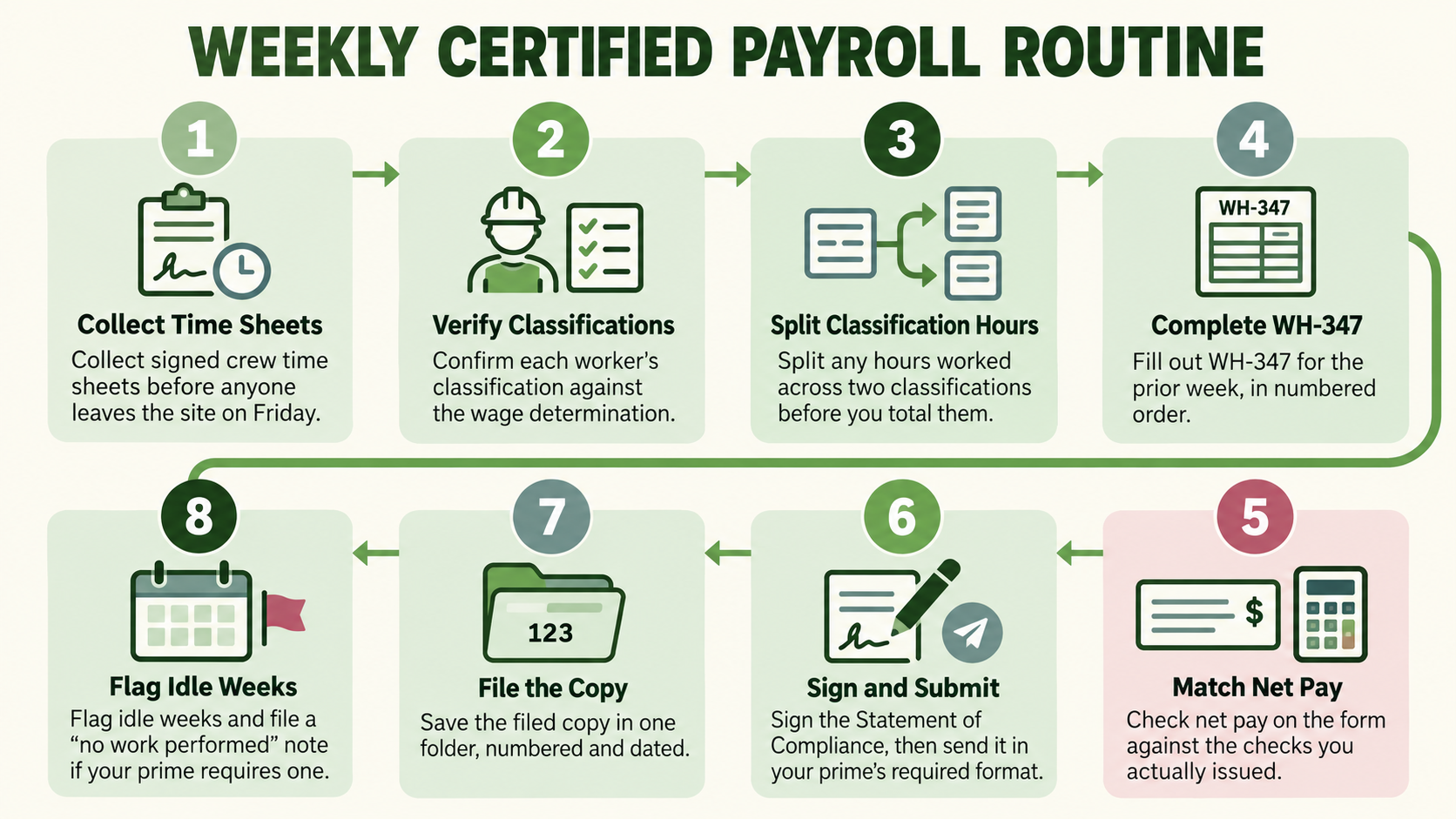
Consistency beats a catch-up marathon in January. So here’s a weekly routine you, or your assistant, can follow:
- Collect signed crew time sheets before anyone leaves the site on Friday.
- Confirm each worker’s classification against the wage determination.
- Split any hours worked across two classifications before you total them.
- Fill out WH-347 for the prior week, in numbered order.
- Check net pay on the form against the checks you actually issued.
- Sign the Statement of Compliance, then send it in your prime’s required format.
- Save the filed copy in one folder, numbered and dated.
- Flag idle weeks and file a “no work performed” note if your prime requires one.
Keep this list in a shared spreadsheet so nothing slips. That way, anyone in your office can see what’s done and what’s due.
Certified payroll is one piece of a bigger picture. To see how it fits with bid letting, change orders, and retainage, read our guide to the DOT project management system. If the paperwork load is bigger than one form, our green industry remote assistant services cover the rest of the back office.
How to Fill Out WH-347: Frequently Asked Questions
Do I have to use Form WH-347, or can I use my own payroll report?
You can use any format that carries the same information and a signed Statement of Compliance. However, most primes expect the WH-347 layout, so using it avoids an argument.
How long does it take to fill out WH-347 each week?
Expect 30 to 60 minutes for a small crew once your records are organized. Disorganized time sheets easily double that.
How much does it cost to outsource certified payroll?
Pricing depends on crew size, how many active contracts you’re running, and whether you need backlog cleanup first. Most contractors find the cost lands well below what a single delayed invoice costs them in cash flow.
How long does it take to catch up months of missing payrolls?
With complete time records, a multi-month backlog usually takes a few focused weeks. Missing or handwritten records slow it down, so gather what you have before your first call.
Do I file certified payroll for my own hours as the owner?
Yes, if you performed covered manual work on the site. Owners and working supervisors get listed with a classification, just like anyone else on the crew.
How long do I keep certified payroll records?
Keep payrolls and supporting documents for at least three years after the work is completed. Store them digitally, because primes and auditors often ask for old weeks at inconvenient times.
What’s the difference between certified payroll and regular payroll?
Regular payroll pays your team. Certified payroll proves to the government that you paid the prevailing wage, week by week, in a signed report.
Can a bookkeeper handle this, or do I need a specialist?
A detail-oriented bookkeeper can absolutely handle it with real training on wage determinations. Trouble usually starts when the second contract lands and the weeks pile up.
Is DOT work worth the paperwork for a small landscape company?
Government work pays reliably and repeats year after year, so yes for most contractors. The paperwork is the entry fee, and it gets easy once a system carries it.
Ready to Get Your First DOT Payroll Filed?
You handle the field. Let us fill out WH-347 while you run the crew. Offshoot Virtual Landscape Services can set up your classifications, clean up any backlog, and file every week for as long as the contract runs, so your invoices move on schedule.
Call 828-699-8022 or book a free 30-minute consultation with Offshoot Virtual Landscape Services. Bring your questions and your messiest stack of paperwork, because we’ve seen worse and we’ve fixed worse.
I’m an offshoot of your business.
About the Author
Debbie Neese is the founder of Offshoot Virtual Landscape Services, LLC, a virtual assistant and back-office firm serving landscapers, hydroseeders, lawn care companies, and tree services across the U.S. She started in the green industry in 2010, studying horticulture and working at a nursery, and founded Offshoot in 2012. She holds a Horticulture Certification and an Associate of Science in Business Administration. Her gardening expertise has appeared in Men’s Journal, Martha Stewart, Southern Living, The Spruce, Well+Good, and Family Handyman.


