

DOT Subcontract Administration: A Contractor’s Guide
The Easy Part Is Already Done
You won the bid.
Go ahead and take a second to appreciate that. Beating out the competition for a DOT subcontract is no small thing. You put the numbers together, you knew your scope, and you came in at the right price. That part? You nailed it.
But here’s what nobody warns you about when you’re celebrating that award notification: the real work hasn’t even started yet. And I’m not talking about hydroseeding, erosion-control matting, finish grading, or tree work. I’m talking about everything that must happen in the background. Certified payrolls, contract reviews, invoice submissions, change order documentation, and the bid letting calendar keep spinning whether you’re ready or not.
That’s the part that quietly unravels even the most capable green industry contractors I’ve ever worked with.

Let an expert VA take the headache out of your day so you can get back to business!
Let an expert VA take the headache out of your day so you can get back to business!
I’m Debbie, and I run Offshoot Virtual Landscape Services, LLC. I work remotely with landscape and hydroseeding subcontractors, including the ones doing NCDOT and federally funded work. I help them build the back-office systems that keep their companies compliant, cash-flowing, and growing.
I stepped into pure administrative chaos and mapped how DOT subcontracts flow from bid to final payment. Then I built SOPs from scratch.
I’ve seen what happens when those systems don’t exist. I’ve also seen what happens when they do.
Let me show you the difference.
The $80,000 Wake-Up Call Nobody Talks About
When I first started working with an NCDOT landscape subcontractor, I expected to find some disorganization.
What I found instead was a slow-motion cash flow crisis hiding in plain sight. All of it was online, digital, and completely tangled.
His invoices sat unpaid — not because the prime contractor was refusing, but because the submissions were wrong. Quantities didn’t match what the contract required. Documentation was missing.
The back-office workflow should have been humming like a well-maintained Finn B-40. Instead, it was sputtering like a hydroseeder on a cold morning with a clogged pump.
By the time I came on board in September 2023, he was sitting on close to $80,000 in unpaid invoices. Nobody had correctly processed or paid them.
His certified payrolls were behind, too. And bids? He barely had time to look at the letting calendar, let alone price and submit anything. He was out in the field all day and home exhausted every night, with zero admin support.
Here’s the thing that stuck with me: this wasn’t a failure of skill. He was excellent at his actual work. His crews installed the erosion control right. The seed went down at the right rates. His crews showed up. The problem was that nobody had ever built the administrative infrastructure around him. The systems, the SOPs, the filing logic, the invoicing cadence — that’s what DOT work demands.
How We Fixed It
It took about six months of digging, researching, tracking down correct quantities, and creating order out of chaos. But by the time we were done, there was a system. And once a system exists, it works everywhere.
That experience is essentially the foundation Offshoot Virtual Landscape Services, LLC is built on. Because of what I learned cleaning up that situation, I turned it into a repeatable process. Now, no contractor I work with ever has to sit on $80,000 in unpaid invoices again.
Q: If my certified payroll and invoicing are already behind on an NCDOT job, is it too late to fix it?
A: It’s rarely too late, but the longer it sits, the harder it gets. Quantities become harder to verify, and prime contractors grow less cooperative. Payment timelines extend, too. The sooner you bring in someone who can reconstruct the paper trail and correct the submissions, the sooner money starts moving again.
What Is NCDOT Bid Letting — And Why Missing One Costs You More Than You Think

The NCDOT bid letting calendar is, in the simplest terms, the heartbeat of your pipeline. NCDOT releases construction projects for bid on a regular weekly cycle. These are called lettings. Prime contractors review those project packages and build their bids. Then they reach out to subcontractors like you to price specific scopes: erosion control, hydroseeding, landscaping, seeding and mulching.
If you’re not watching that calendar consistently, every single week, you are leaving money on the table. Guaranteed.
I’ve watched it happen. One of my clients kept missing letting cycles — not because they didn’t care, but because there was no system to catch them.
Nobody was monitoring. Nobody was flagging the projects that matched their scope and geography. Those missed opportunities don’t announce themselves. They just quietly disappear, and three months later you’re wondering why your pipeline feels thin.
Here’s what most contractors don’t realize: prime contractors are moving fast. They’re assembling their bids under tight deadlines. The subs who are already visible and ready are the ones who get the call.
If you’re not tracking the letting calendar, you’re not in the room when those conversations happen.
Prime Bids vs. Subcontractor Scope
The difference between prime contractor bids and subcontractor scope is also worth understanding clearly. As a sub, you’re not bidding the whole project. You’re pricing a defined portion of it, usually tied to specific line items in the NCDOT contract: erosion control measures, permanent seeding, mulching, plant installation, grading, drainage, or hydroseeding.
Your numbers feed into the prime’s overall bid, so your turnaround time matters enormously. A prime who can’t get a reliable sub quote on time will find one who can. And they’ll remember that at the next letting cycle.
Missing a single letting can mean missing weeks of work. In a business where cash flow is already stretched thin by retainage and payment cycles, that’s not a minor inconvenience. That’s a real problem.
Here’s How I Handle It for My Clients:
Every week, I monitor the NCDOT letting calendar for upcoming projects that match my client’s scope and service area. I track the letting dates, pull the relevant project documents, and flag the opportunities worth pursuing, making sure nothing slips through.
It’s not glamorous work. But it’s the kind of consistent, disciplined attention that builds a pipeline instead of just hoping one shows up.
Because in this industry, hope is not a system. And a system is exactly what separates the subcontractors who are growing from the ones who are constantly scrambling.
Q: How often does NCDOT release new projects for bid, and where do I find the letting calendar?
A: NCDOT holds lettings on a regular weekly cycle, with project packages posted on the NCDOT Connect bidding website. New opportunities appear consistently throughout the year, so the monitoring never really stops. Missing even one cycle can mean missing the window when a prime was actively building their team.

The Bid Submission Process — Knowing Which Fights Are Worth Fighting
Not every NCDOT project is your project. Knowing the difference is half the battle.
Here’s how I approach it for my clients. I go directly to the NCDOT bidding website and filter by the divisions my clients are working in. Each division covers a specific geographic region of North Carolina, so right away I’m narrowing the field to what’s relevant and reachable.
Then I check the letting dates, because deadlines don’t negotiate. I start opening the bid packages one by one.
What’s Inside a Bid Package
Inside each package is a Proposal. That’s where the real scanning begins. I’m looking through the itemized list for the specific line items my client performs: erosion control measures, permanent seeding, hydroseeding, landscaping, plant installation.
If those items are on the list, this package is worth pursuing. If they’re not, I move on without wasting anyone’s time.
It sounds straightforward. And once you’ve done it enough times, it is. But for a contractor juggling crews, equipment, and job sites all day, finding the time is hard. Doing it consistently, every week, every letting cycle, is the part that almost never happens without dedicated support.
That’s exactly the gap Offshoot fills.
Q: How much time does a landscape subcontractor usually have to submit a bid to a prime contractor on an NCDOT project?
A: Turnaround windows are tight. Often it’s just 24 to 72 hours from when a prime reaches out, depending on the letting deadline. Primes are assembling bids fast and won’t wait for a sub who isn’t ready. Having your pricing methodology and line-item rates organized in advance is the only way to consistently hit those windows. I’m always watching the lets for my clients. The DOT puts them out far in advance, so I have time to price them and send them out a week before they let, to be proactive.
Reading the Proposal — And Catching What Others Miss

Reviewing a bid package isn’t just about checking boxes. Sometimes it’s about catching something that nobody else caught, including the architect who designed the project.
Early in my work with one NCDOT landscape contractor, I was scanning a project proposal when I noticed a plant species in the specifications that made me stop cold. I knew that plant. I knew it well from my years of experience in landscape design. And I knew, without a doubt, that nobody should have specified it. It had no business being planted in the mountains of Western North Carolina.
The architect had spec’d a plant that would thrive beautifully in the warmer, more temperate zones farther south. But up in the WNC mountains, with the frost depths and temperature swings those elevations bring, those plants would struggle and eventually fail. We’re talking thousands of dollars in plant material, installation labor, and warranty replacements waiting to happen.
I flagged it immediately, and told the prime contractor we would not warranty those plants. We wouldn’t return to replace them when they died, either — because they would die. He took it to the architect, and the architect updated the plant material before anyone dug a single hole.
That’s the kind of thing only a person actually reading what’s in front of them will catch. It’s not just processing paperwork — it’s bringing real field knowledge to the desk. That’s the difference between a virtual assistant who handles documents and one who understands the industry those documents concern.
How Award Status Gets Tracked
Once a bid goes in, the work doesn’t stop. It shifts. Now the job is staying on top of what happens next.
After each submission, I monitor the Awarded Lettings on the NCDOT website. I check the status of every bid my clients have submitted. Did we get the award? Did the prime go a different direction? Did NCDOT pull or postpone the project?
Every one of those outcomes affects what happens next in my client’s pipeline. None of them should come as a surprise.
Most contractors, if they’re being honest, don’t have a reliable system for this. The bid goes in, life gets busy, and award notifications fall through the cracks. Weeks later they might remember to check, or they find out from someone else entirely. That’s not a pipeline. That’s a lottery.
Tracking award status consistently means my clients always know where they stand. It means we can follow up when appropriate and adjust the pipeline forecast when needed. It also means a winning bid actually turns into a signed subcontract, not just a notification someone buried in an inbox.
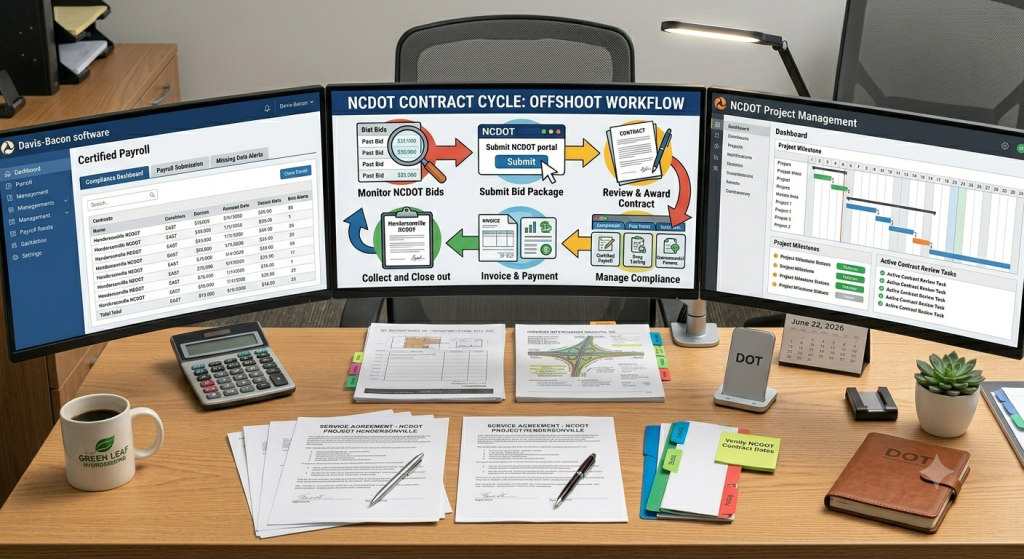
The Contract That Should Never Have Been Signed As Written
Q: What contract clauses put NCDOT landscape subcontractors at the most risk?
A: The most dangerous clauses are pay-when-paid provisions, undefined scope language, warranty terms that cover work you didn’t design or engineer, and change order sections that allow verbal direction without written authorization. Any clause that gives the prime unilateral discretion over what you get paid — or when — deserves a hard look before you sign.
I reviewed a subcontract for a landscaping contractor. It wasn’t an NCDOT job, but the lesson applies everywhere. My AI-powered contract scanning process flagged several clauses that put my client at serious risk.
I documented every concern and explained what each one meant in plain language. I strongly recommended that specific language be revised before he put pen to paper.
He wanted the business. He signed it anyway.
I understood the impulse. Work is in front of you, and a prime contractor is ready to move. Paperwork slowing things down is the last thing you want. But that contract had no teeth protecting him, and the prime contractor knew it.
What followed taught a masterclass in what happens when nobody defines scope with ironclad clarity.
When “They’ll Pay Us” Doesn’t Hold Up
During the project, the PM supervisor called my client directly. He instructed him to hydroseed a section that was not in the original scope of work.
I flagged it immediately. I told him that area wasn’t in the contract and that we needed written authorization before mobilizing.
His response? “Aw, they’ll pay us.”
They didn’t.
The PM was under pressure. County inspectors were breathing down his neck, and he needed that section remedied fast.
My client mobilized quickly and efficiently, did the work professionally, and followed the verbal instructions he was given. And when the invoice came in, they paid less than half of what was owed for that additional work. There was no documentation, no written authorization, and no recourse.
But that wasn’t even the most expensive lesson on that job.
The $13,000 Change Order That Should Have Had an Architect’s Signature
A subsequent change order came through that required adding sod and building up the existing grade by two to three inches, on an area that had already been hydroseeded. When I saw that, I immediately requested that a landscape architect review and draw out the area to be sodded. This would make sure it could accommodate the sod and handle drainage correctly.
It was a straightforward professional safeguard. The kind of thing that protects everyone involved.
The PM supervisor brushed it off. Didn’t need an architect, he said. The PM overruled my client, the subcontractor who had raised the concern. He did exactly what the PM directed him to do.

The drainage around that building failed. Water wasn’t moving the way it should have been — because nobody had properly engineered the grade before the sod went down. And who took the blame for the drainage issues?
Not the PM supervisor who dismissed the architect review. Not the prime contractor who approved the change order without proper oversight. The PM had overruled my client, the subcontractor who had raised the concern, and he’d done exactly what he was instructed to do. The changes in the contract would have safeguarded against this repercussion.
In an act of pure vindictiveness, the prime forced my client to pay to correct a grading problem that was never his to begin with. A problem that a landscape architect’s review — the one I requested and the PM supervisor waved away — would almost certainly have prevented entirely.
The Final Bill
The total damage across that entire project? Over $13,000. Gone.
There was no meaningful recourse. The contract hadn’t been revised, the scope creep hadn’t been authorized in writing, and the architect had been cut out of the loop on a change order that absolutely required one.
I tell this story not to relitigate a painful situation. I tell it because it contains almost every warning sign I now watch for in every contract and every change order I touch.
Unsigned scope changes. Verbal instructions from PMs under pressure. Change orders that alter grade, drainage, or structural relationships without requiring an engineer or architect to sign off. These are the moments where a subcontractor’s entire profit margin, and then some, can disappear.
The lesson here isn’t just about contract language. It’s about knowing when to hold the line on professional process — even when a PM supervisor is impatient, even when your client wants the business, and even when saying “we need an architect on this” feels like you’re slowing things down.
Sometimes slowing things down is exactly what saves you.
Certified Payroll & DOT Compliance — The Work That Never Takes a Week Off
One area of DOT subcontract work separates contractors who get paid on time from contractors who are constantly chasing money: certified payroll.
Not bidding. Not field performance — and not even invoicing.
Certified payroll.
Most landscape and hydroseeding subcontractors doing federally funded work understand, at least vaguely, that certified payroll is required. What they underestimate, consistently, is how unforgiving it is.
This isn’t paperwork you can catch up on when things slow down. It doesn’t care that you had three crews out this week, an equipment breakdown on Tuesday, and a site inspection on Friday.
It comes due every single week, without exception. And the consequences of falling behind aren’t administrative headaches.
They’re financial ones.
Here’s the simplest way I know to say it. Submit your certified payroll wrong or late, and you don’t get paid.
Full stop. The prime contractor cannot release payment to a subcontractor with outstanding or deficient certified payroll submissions.
That money sits, sometimes for weeks. Meanwhile you’re covering payroll, fuel, materials, and overhead out of your own pocket.
I’ve seen what that does to a contractor’s cash flow. It’s not pretty.
What Certified Payroll Actually Is — And Why It Exists

Certified payroll is a federal requirement under the Davis-Bacon Act. That’s legislation that applies to federally funded construction projects and requires workers be paid prevailing wage rates for their trade and geographic area.
On every qualifying project, subcontractors must submit a completed WH-347 form each week. It documents every worker on that job: name, trade classification, hours worked, hourly rate, and deductions.
The purpose is straightforward: to ensure federal dollars don’t undercut local wage standards. The execution, however, requires precision.
Every blank on that form exists for a reason. Dates have to be correct, and every worker has to be properly classified.
An incomplete or misdated form doesn’t just draw a flag. It triggers a payment hold that freezes everything downstream until someone fixes and resubmits it.
This is not a system with much patience for “we’ll fix it next week.”
Q: Who submits certified payroll on an NCDOT subcontract — the prime or the subcontractor?
A: Subcontractors submit their own certified payroll directly. Each sub on a federally funded project is responsible for filing their own WH-347 for every week work is performed — regardless of whether the prime reminds them. Submission typically goes through the prime contractor’s compliance portal or directly to their office, depending on the contract requirements.
Where Contractors Fall Behind — And How I Keep Them Current
The two most common certified payroll mistakes I see are also the most preventable: incomplete forms and incorrect dates worked.
They sound simple. And they are simple, which is exactly why they’re so easy to overlook when a contractor is filling out compliance paperwork at the end of a long week in the field.
A blank field here, a transposed date there — and suddenly a payment that should have released on schedule is sitting in limbo. Someone has to track down the error.
How I Keep Certified Payrolls Current
My process is built around my own Response Form methodology and a system I’ve developed specifically for this work. It ensures certified payrolls are completed accurately and submitted on time, every week, without exception.
I work from the regular payroll cycle once it’s processed. I gather what I need through my established field data collection system, and make sure every form that goes out is complete, correctly dated, and properly documented before it ever hits a submission deadline.
What that means in practice for my clients is simple: their certified payrolls are current, and their compliance standing is clean. Paperwork never holds up their payments, because I handle it on Monday.
Because in this business, cash flow isn’t just about winning bids and doing good work. It’s about making sure the administrative machinery that releases your money runs the way it should, every single week, whether you’re on a job site or not.
That’s what Offshoot does. Week in, week out, without fail.
Q: What happens if a certified payroll error is discovered after it’s already been submitted on a DOT project?
A: You submit a corrected WH-347 marked as a revision. The prime’s compliance team reviews it, and if the correction is accepted, payment can proceed. The problem is timing — a correction caught late in a pay cycle can push your payment back by weeks. Catching errors before submission is always faster and less damaging than correcting them after.
Accounts Receivable & Invoice Management — Where the Money Actually Gets Collected

[IMAGE: remote worker’s organized desk]
Winning the bid is exciting. Doing the work is satisfying. Getting paid? That’s where it gets complicated.
Invoicing on an NCDOT subcontract isn’t like billing a homeowner and waiting for a check. It takes, and I say this with complete sincerity, something close to an Einstein-level of organizational discipline. That’s especially true when you’re juggling multiple contracts at the same time.
Every contract has its own requirements: its own submission process, documentation checklist, price sheets, line item codes, and inspector requirements at mobilization.
Add conditional lien waivers, certified payroll submissions, and quantity reconciliations to that stack. Now you have a paperwork ecosystem that’s entirely unique to DOT work, and entirely unforgiving when something is missing or out of sequence.
Most landscape and hydroseeding subcontractors who are new to NCDOT work discover this the hard way. They submit an invoice and wait, and wait, and then find out weeks later that nobody processed it. Maybe a lien waiver was missing, the quantities didn’t match inspector records, or the prime never received that pay period’s certified payroll.
Meanwhile, their payroll keeps running. Their fuel costs keep climbing. And that invoice sits in a queue going nowhere.
The Art of Keeping Every Contract Straight
Here’s what makes this genuinely difficult: no two contracts are the same.
The price sheet for one contract looks different from the next. Submission portals vary by prime contractor. And the documentation one inspector requires isn’t necessarily what the next one expects.
Until you’ve worked inside enough of these contracts to build pattern recognition, you’re constantly scrambling. You’re hunting for the right form, the right rate, the right contact, the right sequence.
I’ve built a proprietary tracking system, my own IP, that keeps every active contract organized by its specific requirements. It tracks what I’ve invoiced, what payrolls I’ve submitted, what documentation went out and came back, and what’s still open.
Every contract gets its own treatment, because every contract demands it.
What that means for my clients is that nothing gets missed and nothing gets submitted out of sequence. Nothing sits uninvoiced because someone forgot to track what was installed last week versus what was billed the week before.
In a business where cash flow is everything, that kind of systematic precision isn’t a nice-to-have. It’s the difference between a healthy bank account and a cash flow crisis.
Q: What documentation does a landscape subcontractor typically need to submit with an NCDOT invoice?
A: It varies by prime contractor and contract, but the standard stack includes the invoice itself priced against contract unit prices, a conditional lien waiver, certifications, receipts for product, certified payroll submissions current through the pay period, and quantity documentation verified against inspector records. Missing any one of these can put the invoice on hold until it’s resolved.
When Primes Don’t Pay — And What Happens Next
Most subcontractors, when a prime contractor is slow to pay, do one of two things. They wait politely, or they make a few phone calls that go unreturned.
And then they wait some more.
I do something different.
Just this week, I had a prime contractor who had gone over their allocated quantities on a job. They needed to submit a change order before payment could be released.
In my experience, that kind of situation can drag on for two months. The prime moves at their own pace while the subcontractor absorbs the cash flow hit in silence.
Not this time.
I issued a formal stop work notice. I sent a letter citing the applicable NC state statutes on payment timelines and assessed the interest due on the late payment.
Then I made a direct call to the right people. Not the PM who wasn’t returning messages, but the decision-makers who actually had the authority to move things.
That payment is being deposited as I write this.
When It Takes More Than a Phone Call
On another recent occasion, a different prime contractor was dragging their feet. It required a different set of tools entirely.
I made a direct call to their division supervisor, formally requested their payment bond, and filed a FOIA request. Within two weeks, a check arrived by mail.
Here’s what most subcontractors don’t realize: NC statutes provide real, meaningful protection for subs on payment timelines. That includes the right to charge interest on late payments and the right to pursue a prime contractor’s payment bond when invoices go unpaid.
These aren’t obscure legal technicalities. They exist specifically to protect subcontractors from being used as involuntary lines of credit by prime contractors who know most subs won’t push back.
Most contractors don’t push back because they don’t know how. Or they don’t have time. Or they’re worried about burning a relationship with a prime they want future work from.
I push back because it’s my job. And because my clients deserve to be paid for work they’ve already done.
Retainage Receivable — The Money You Earned That You’re Still Waiting For

Retainage receivable is a fact of life on DOT subcontracts.
A percentage of every invoice, typically five to ten percent, is held back by the prime contractor until the project reaches substantial completion. On a large contract, that number adds up quickly.
And it sits there, earned but untouchable, until the right conditions are met.
The key to retainage receivable release is knowing exactly when and how to request it. It also means making sure every prerequisite is in place before you do.
Most prime contractors will require final lien waivers before releasing retainage. That means the waiver has to be prepared correctly, submitted at the right moment, and followed up on if it doesn’t move on schedule.
How I Track Retainage So Nothing Gets Missed
I track every client’s retainage balance as an active line item. It’s not something to think about only when the project winds down — it’s monitored throughout the life of the contract. That way, when completion arrives, the release process begins immediately and nothing delays that final payment unnecessarily.
Because that retainage receivable belongs to your company. You earned it the day the work went in the ground.
Getting it back promptly is just the last step. It’s part of a system that works from the first bid all the way to the final check.
Q: How long does it take to receive retainage after an NCDOT landscape project reaches substantial completion?
A: It depends on how quickly the prime receives final acceptance from NCDOT and whether all closeout documentation — including your final lien waiver — is in order. In practice, it can range from a few weeks to several years, depending on the project’s duration. Contractors who track their retainage balance throughout the project and initiate the release process immediately at completion consistently get paid faster than those who wait for the prime to prompt them.
Change Order Administration — The Step Most Contractors Skip Until It Hurts
Picture this: your crew loads up at 6am. Truck, trailer, hydroseeder, materials.
They drive forty-five minutes to a job site because a PM called yesterday. He said there was additional work to do.
They arrive ready to go. And then they stand there.
Because nobody wrote down exactly what needed to be done. There’s no material list, no written scope, and no certifications for the materials they’re supposed to install. There’s no documentation of what the PM actually requested or agreed to, either.
Just a verbal instruction from the day before. A crew stands in the morning cold, waiting for direction that was never properly captured.
That mobilization just cost your client real money: labor, fuel, equipment time, and lost productivity elsewhere.
And if the work somehow gets done anyway, the problems don’t stop there. Without proper field documentation from the job site, nobody can invoice accurately or complete the certified payroll correctly.
Everything downstream from that moment is compromised. The foundation, a properly processed change order with written direction, was never in place.
This is not a hypothetical. It’s a pattern I see repeatedly in contractors without change order administration systems built into how they operate.
What a Properly Administered Change Order Actually Looks Like
Change order administration on a DOT subcontract follows a specific sequence, and every step exists for a reason.
A field change might mean a PM requests additional work, site conditions require a scope adjustment, or quantities exceed what the original contract allocated. Either way, the first move is not to mobilize.
The first move is to submit a bid for the change order work and send it in for formal approval.
I need to price that bid correctly against the contract’s established unit prices and scope it accurately. Then I submit it through the right channel to the right person.
It is not a casual estimate dashed off in a text message. It is a formal document that starts the clock on a process.
From Approval to Invoice
Once the prime approves that change order bid, and not one moment before, my Response Form goes out.
That form captures the written direction for the work — what the crew is doing, where, and who’s doing it. It also captures what materials they’re using and under whose authorization.
Only when that form comes back completed and signed does mobilization begin.
Then, after the work is complete, the crew leader gathers field documentation on-site. That means what the crew installed, what materials they used, quantities, and certifications.
Everything the invoice and the certified payroll will need to be completed accurately and on time.
That sequence — bid, approval, Response Form, mobilize, document, invoice — is what separates a paid change order from one that creates a dispute, a delay, or a loss.
Q: How are change orders priced on an NCDOT landscape subcontract?
A: Change orders on NCDOT subcontracts are typically priced against the unit prices already established in your original contract. If the scope involves work or materials not covered by existing line items, you’ll negotiate new unit prices with the prime — but those new prices need to be in writing before any work begins. Pricing a change order against the wrong rate is one of the fastest ways to leave money on the table.
What Happens When the Sequence Gets Skipped
We already talked about what happened when a PM supervisor pressured my client to hydroseed a section that wasn’t in scope. “Aw, they’ll pay us” turned into an unpaid invoice and a painful lesson about verbal authorizations.
We also talked about the sod installation on an already hydroseeded area. Skipping an architect review on that change order led to drainage problems, blame that landed on the wrong party, and thousands of dollars paid for someone else’s engineering failure.
Both of those situations had change order administration failures at their core. They performed the work without written direction. My client accepted the scope without proper documentation.
And when things went wrong, as they eventually do when someone cuts corners, nothing in writing protected the subcontractor.
What Skipping the Process Actually Costs
Here’s the operational reality when change orders get skipped: crews go out without written direction or a material list.
Nobody captures receipts. Nobody collects material certifications at the supply store.
When the crew comes back, nobody has what they need to invoice correctly or complete the certified payroll accurately. Everything stalls, or worse, goes out with errors that trigger holds and disputes.
The cost of a poorly administered change order isn’t just the work that doesn’t get paid. It’s the ripple effect through every administrative process that depends on accurate field documentation to function.
My Response Form methodology exists specifically to break that pattern. It creates a paper trail from the first conversation about additional work all the way through to the invoice and the certified payroll. Every step gets documented, every authorization gets captured in writing, and every mobilization is preceded by a completed form, regardless of how impatient a PM supervisor gets about timing.
Because I’ve held that line before, even when it was uncomfortable. And the clients who trusted that process were protected.
The ones who didn’t learned an expensive lesson instead.
The Result — What This Looks Like When Everything Works

I want to tell you about one of my clients.
When I came on board, he was good at what he did. Excellent, actually.
His crews were skilled, his equipment was well maintained, and he knew his trade inside and out.
What he didn’t have was a back-office system that matched the quality of his field work. No organized bid monitoring. No certified payroll system that kept pace with the work. No contract administration infrastructure, and no consistent invoicing process.
Just a capable contractor doing his best to keep up with the paperwork, while running a full operation in the field.
Sound familiar?
Within the first year of working together, his average monthly revenue increased by nearly 65%.
Not because he suddenly became better at hydroseeding, and not because the market shifted in his favor. It wasn’t luck on a couple of big bids, either.
Because we built the systems.
The Bid Pipeline That Never Existed Before
Once we had consistent bid-letting monitoring in place, opportunities stopped slipping by unnoticed. Every letting cycle got watched, every relevant project got flagged, and every submission deadline got tracked.
Bids went out regularly. I tracked every award status. The pipeline stopped happening by chance. We actively built and managed it instead.
That alone changed the revenue trajectory. But it wasn’t the whole story.
The Products Nobody Else Was Offering
Part of my role for this client went beyond administration. I started looking at what we were offering, and more importantly, what we weren’t.
I researched the full range of products available for the types of work we were doing. I identified several add-on products that would significantly improve the longevity and performance of their installations.
Products that complemented what they were already doing but weren’t in scope.
When I asked my client why we weren’t using them, his answer was simple: too expensive.
I told him I could sell them.
He said okay.
And I did.
The Payoff
Within that first year, the expanded product offerings generated tens of thousands of dollars in additional hydroseeding bid revenue. That’s revenue that hadn’t existed before, because nobody had stopped to ask why we weren’t offering what the work clearly called for.
My client’s reaction when he saw the results? He was genuinely surprised.
And then he started bragging, because none of his competitors were offering these products.
In a competitive subcontracting market where most contractors are bidding the same basic scope at similar prices, that differentiation mattered. It made his proposals stronger, his installations more defensible, and his reputation for quality more concrete.
That’s what happens when someone is paying attention to your business from the inside.
Q: What does it cost to work with a virtual assistant who specializes in NCDOT landscape subcontract administration?
A: Offshoot works at a part-time cost with full-time availability — meaning you’re not paying a full-time salary, benefits, or overhead. You’re only paying for the hours you need. And bonus, no training required! The investment varies based on the scope of services, but contractors consistently find that one recovered payment, one avoided contract mistake, or one additional bid captured more than covers the cost of the engagement. The first step is a free 30-minute consultation at 828-699-8022.
The Systems That Made It All Possible
The revenue increase didn’t come from a single factor. It came from everything working together.
I monitored bid letting consistently, so opportunities stopped falling through the cracks. I reviewed contracts before signing. That kept my client from being exposed to language that could cost him money or leave him with no recourse.
I submitted certified payrolls accurately and on time every week, so compliance deficiencies never held up his payments. I processed invoices correctly with all the required documentation, so he collected every dollar he earned.
I administered change orders properly, so additional work translated into additional revenue instead of disputes and losses.
And when prime contractors moved slowly or pushed boundaries, I applied the right pressure through the right channels. That way, my client didn’t have to choose between keeping the peace and getting paid.
We built the systems. We maintained compliance. Bids went out every week.
A contractor who was quietly struggling with back-office chaos walked into his second year with a different business. It looked, and performed, completely differently than it had before.
That’s what Offshoot does.
Is Your Back Office Keeping Up With Your Field Work?
If you’ve read this far, chances are something in this article hit a little close to home.
Maybe it was the $80,000 in unpaid invoices sitting in digital chaos. Or the contractor who signed a contract he hadn’t fully read and paid dearly for it. Or the crew that mobilized without written direction and came back with nothing useful for the invoice.
Or maybe it was simply the realization that your letting calendar has gaps. You’re not entirely sure what you’ve been missing.
Whatever landed, I want you to know that none of it is unusual.
These are the exact challenges landscape and hydroseeding subcontractors face every single day. They’re trying to run a field operation and a back office simultaneously, without the infrastructure to support both.
You are exceptional at what you do out there.
The erosion control, the hydroseeding, the plant installations, the site work — that’s your craft. You’ve spent years perfecting it.
You shouldn’t have to be equally exceptional at certified payroll, contract redlining, bid monitoring, and accounts receivable, all at the same time.
That’s what Offshoot is for.
What Working With Offshoot Actually Looks Like
I work remotely with NCDOT landscape and hydroseeding subcontractors, and contractors doing federally funded work with agencies like the National Park Service and FHWA. I build and run the back-office systems that keep their companies compliant, cash-flowing, and growing.
That means weekly bid letting monitoring, so you never miss an opportunity. Contract review before you sign anything, with me identifying and explaining every red flag in plain language.
I submit your certified payroll accurately and on time every single week. I process your invoices correctly with every piece of required documentation in place.
Change orders administered from field direction through to final payment.
And when a prime contractor is slow to pay, I bring the knowledge and the tools to do something about it.
Part-time cost. Full-time availability. One hundred percent green industry expertise.
I’m not a generalist virtual assistant who figured out landscaping along the way. I built these systems from the ground up, inside real contracts, solving real problems, and I bring all of it to every client I work with.
Let’s Look At Your Operation Together
If you’re a landscape or hydroseeding subcontractor doing NCDOT work, or trying to break into it, let’s spend thirty minutes looking at your process together.
No pressure, no pitch — just an honest conversation about where your back office stands. We’ll talk about where the gaps might be costing you time, money, or compliance standing.
Here’s what I’ve learned after years of doing this work: most contractors don’t know what they’re missing until someone who knows what to look for takes a look.
Let me take a look.
Frequently Asked Questions
Q: Does Offshoot Virtual Landscape Services work with subcontractors outside of North Carolina?
A: Yes. While one of our areas of expertise is NCDOT and federally funded work in North Carolina, the systems — certified payroll, change order administration, contract review, bid monitoring — apply to contractors working with other state DOTs, the National Park Service, FHWA, and similar agencies. If your work involves Davis-Bacon compliance and DOT-style contracting, Offshoot’s process is built for it.
Q: What’s the difference between Davis-Bacon prevailing wage and standard minimum wage on a DOT landscaping job?
A: Minimum wage sets a floor for all workers. Davis-Bacon sets a trade-specific floor based on what workers in that classification are actually paid in your county. On a federally funded project, a landscape laborer in one North Carolina county may have a different prevailing wage rate than the same worker in another county. Paying the wrong rate — even accidentally — can trigger a compliance violation that holds up your payments.
Q: Can a landscape subcontractor be removed from an NCDOT project for certified payroll violations?
A: Non-compliance with certified payroll requirements can result in payment withholds, debarment proceedings, and removal from federally funded projects. These aren’t theoretical consequences — they’re enforced. A subcontractor with a history of deficient submissions also becomes a liability to prime contractors, who will simply stop calling. Clean compliance is not just a legal requirement. It’s a competitive advantage.
📞 828-699-8022 Free 30-minute consultation — let’s find your gaps before they find you.


