

Certified payroll for landscapers is a weekly wage report you file on any government-funded job. Federal rules require it under the Davis-Bacon Act, and most crews file it using Form WH-347. Miss those reports, and the general contractor sits on your money until you catch up.
So the paperwork isn’t busywork. It’s the key that unlocks your invoice.
If you’re reading this at 9 p.m. with a truck full of receipts and a stack of unsigned time sheets, you’re in good company. Plenty of hydroseeding and landscape contractors land their first NCDOT job, do beautiful work, and then watch the checks stall. Nobody warned them the office side would be the hard part.
Let’s fix that.
Quick stat: One contractor came to us 6 to 8 months behind on certified payroll. Their work was finished. The money was not.
What Is Certified Payroll for Landscapers?
Certified payroll is a weekly record of who worked, what they did, how many hours they put in, and what you paid them. You sign a Statement of Compliance at the bottom, so the government has your word in writing. Then you send it up the chain, usually to the prime contractor.
The federal government wants proof that workers on public projects earn the local prevailing wage. Because that’s the whole point of the law, the report has to be specific. Therefore, vague notes and round numbers won’t fly.
Davis-Bacon Landscaping Requirements in Plain English
The Davis-Bacon Act applies to federal construction contracts over $2,000. Related laws extend the same rules to federal-aid highway work, which is how most Davis-Bacon landscaping requirements reach your crew. So if federal dollars touch the project, prevailing wage rules usually follow them onto the site.
Here’s what surprises people. Seeding, sodding, hydroseeding, erosion control, matting, and slope repair all count as covered work when your crew performs it on the site. Landscaping isn’t a side dish on a highway job. In fact, the wage determination treats it as construction, which is why certified payroll for landscapers covers more work than most owners expect.
Three rules drive everything else:
- Classify every worker correctly. A laborer, an operator, and a truck driver often carry different wage rates.
- Pay at least the listed prevailing wage, including fringe benefits in cash or through a real benefit plan.
- File a payroll every single week you have workers on that site, even a week with one half-day of work.
Why Certified Payroll for Landscapers Holds Up Your Money
Q: Why won’t the general contractor pay my invoice?
A: Most primes withhold payment until your certified payrolls are current, because their own money from the state depends on complete compliance files. So send the missing weeks, and the payment logjam usually clears.
That single rule explains a lot of sleepless nights. Your crew finished the slope in April. Meanwhile, the invoice sits in a folder because week 12 is missing a signature. Nobody is punishing you.
The prime simply can’t submit an incomplete file, since the state won’t accept it.
Then the problem compounds. One missing week turns into six. Six turns into a season. As a result, you’re financing a government project out of your own pocket, and payroll for your own team gets tight.
Warning: Late payrolls don’t just delay payment. They can also trigger withholding, back-wage findings, and in serious cases, a contract default. Fix small gaps fast.
The Contractor Who Was 8 Months Behind
A hydroseeding and landscaping contractor called me with a problem that had gotten away from him. He was six to eight months behind on certified payroll for a run of government work. Meanwhile, his invoices sat unpaid, and the pile of paperwork had grown intimidating enough that he avoided it.
His work was excellent. The recordkeeping was a shoebox.

Let an expert VA take the headache out of your day so you can get back to business!
How We Dug Out of the Backlog
We started at the bottom of the stack, not the top. First, I rebuilt every week from time sheets, job tickets, and pay records. Next, I matched each worker to the right classification on the wage determination. Then I reconstructed the missing weeks in order and filed them.
The backlog cleared. Because the compliance file was finally complete, the invoices moved, and the money came in.

The SOPs That Kept It From Happening Again
Catching him up solved last season. Instead of stopping there, we built the system that protects every season after it.
Offshoot created standard operating procedures for the crews, so documentation happened in the field instead of in a shoebox. Crews wrote down the day’s work and signed it on site. As a result, nobody had to reconstruct anything from memory later. Offshoot also created response forms the prime filled out, including where the job would take place and the estimated quantity, including pictures, so there were no questions later. When the crew finished, they’d get sign-off from the state inspector. The team then had proof the work was done and confirmation the prime would be paid so we could invoice. This was all created and set up by Offshoot.
That signed documentation did double duty. It fed certified payroll, and it also proved exactly what the crew did that day. Consequently, neither the contractor nor the general contractor ever had to argue about scope, hours, or completed work again.
“The paperwork was never the problem. Habit was.”
How to Fill Out WH-347 Line by Line
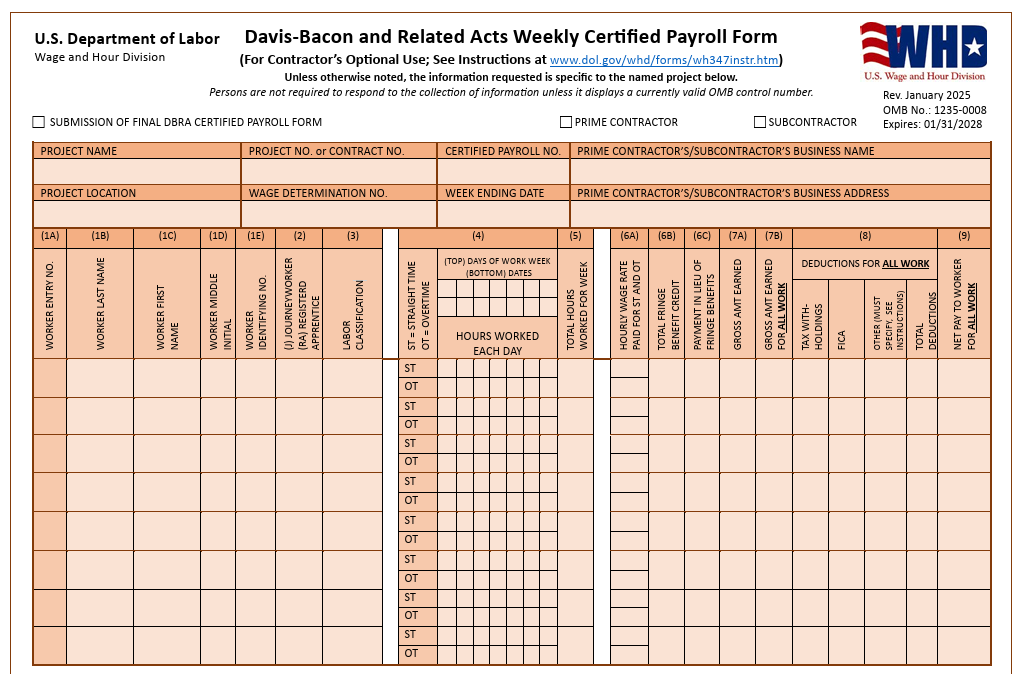
Most certified payroll for landscapers gets filed on Form WH-347, the U.S. Department of Labor’s weekly form. The form itself is optional. However, the information on it is not.
Most primes want the WH-347 layout anyway, so start there.
Before You Fill In a Single Number
Gather four things first, because chasing them mid-form is what turns 20 minutes into two hours:
- The wage determination for your contract, with rates by classification
- Daily time records showing hours by day and by worker
- Payroll records with gross pay, deductions, and net pay (you may have to wait a week until your payroll is finished)
- Your contract number and project details from the prime
Filling In the Form Itself
Then work across the form in order, and the numbers take care of themselves:
- Enter your company name, address, payroll number, week ending date, project name, and contract number.
- Column 1. List each worker’s name and an individual identifying number, such as the last four digits of their Social Security number.
- Column 2. Note withholding exemptions if your prime asks. Most contractors skip this column now, so ask before you fill it out.
- Column 3. Enter the work classification exactly as it appears on the wage determination.
- Columns 4 and 5. Record daily hours by date, then total them. Separate straight time from overtime.
- Columns 6 through 9. Enter the hourly rate, gross earnings, deductions, and net pay.
- Statement of Compliance. Sign page two. Without that signature, the whole payroll is just paper.
The Small Stuff That Gets Payrolls Rejected
Most WH-347 landscaping payrolls bounce back for the same handful of reasons. For example, a crew leader gets classified as a laborer for a day of operating. Similarly, fringe benefits get lumped into the base rate with no explanation.
Watch these five:
- Numbering payrolls out of order, or skipping a week entirely
- Listing a classification that doesn’t exist on your wage determination
- Forgetting to mark a “no work performed” week when required
- Leaving fringe benefits unexplained
- Sending the form unsigned
Certified Payroll NCDOT Subcontractor Basics
As an NCDOT subcontractor, you generally send your certified payrolls to the prime contractor, who submits the compliance file to the state. Your deadline is tighter than most people expect. In fact, federal rules require weekly payrolls within seven days after the regular pay date.
Submission methods change, though. Some primes want a PDF by email, while others require an upload into their own compliance portal. Therefore, ask your prime and the resident engineer for the current format before your first payroll is due, not after the third one is late.
Q: How long do I have to keep certified payroll records?
A: Keep payroll records and supporting documents for at least three years after the work is completed. Store them digitally if you can, because auditors and primes both ask for old weeks at inconvenient times.
Your Plan for Certified Payroll for Landscapers
You have three honest options. Each one works, so pick the one that fits your week.
Option one: do it yourself. Block 60 to 90 minutes every Monday morning. Then build a simple tracking workbook, and never let a week pass unfiled.
Option two: train someone in the office. This works well if you already have an administrator who likes detail. However, they need real training on wage determinations, not just the form.
Option three: hand it off. That’s where we come in. Offshoot handles certified payroll for landscapers and hydroseeding contractors week after week, so Monday morning belongs to your business again.
What Working With Offshoot Actually Looks Like
We keep the process simple, because complicated systems don’t survive a busy spring:
- Free 30-minute consultation. Tell us about your contracts, your crew, and how far behind you are. No judgment lives here.
- Backlog cleanup. We reconstruct and file the missing weeks first, so your unpaid invoices start moving.
- SOPs for your crews. Next, we build the field documentation habit that keeps records clean at the source.
- Weekly filing. Then we handle payrolls on schedule, every week, for as long as the contract runs.
What Life Looks Like Once the Paperwork Is Handled
Picture a Friday afternoon in the middle of the season. Certified payroll for landscapers no longer eats your weekend, because your filings stay current. The prime isn’t calling about missing weeks, and your invoices are moving on their normal schedule.
Meanwhile, your crew signs off on documented work before they leave the site. Nobody argues later about what got done. Because the record exists, questions end in about four seconds.
Now picture the other version. The backlog grows, the invoices sit, and you cover payroll out of savings. In fact, that slow bleed is what pushes good contractors off government work entirely, and it’s completely avoidable.
Certified Payroll for Landscapers: Common Questions
Q: What is certified payroll for landscapers?
A: It’s a weekly report of hours, classifications, and wages for every worker on a government-funded landscape project, signed under a Statement of Compliance. Most contractors file it on Form WH-347, since primes expect that layout.
Q: Does hydroseeding count as covered work under Davis-Bacon?
A: Yes. In fact, hydroseeding, erosion control, seeding, and slope stabilization all fall under prevailing wage rules when performed on the site of a covered project.
Cost, Timing, and Catching Up
Q: How much does it cost to outsource certified payroll?
A: Pricing usually depends on crew size, number of active contracts, and whether you need backlog cleanup first. However, most contractors find the cost lands well below what one delayed invoice costs them in cash flow.
Q: How long does it take to catch up months of missing payrolls?
A: With complete time records, a multi-month backlog typically takes a few focused weeks. Missing or handwritten records slow it down, so gather what you have before the first call.
Q: Can I fill out WH-347 myself?
A: Absolutely. Plenty of contractors do, especially with one small crew and one contract. However, trouble usually starts when the second contract lands and the weeks pile up.
Q: What happens if my certified payroll is late?
A: Your prime can withhold payment until the file is current. Persistent problems can lead to back-wage findings or contract action, so late is worth fixing immediately.
Q: Do I have to file a payroll for a week with no work?
A: Many primes require a “no work performed” statement for those weeks to keep the numbering sequence intact. Ask yours, because a gap in the sequence looks like a missing payroll.
Q: Is certified payroll worth the trouble for a small landscape company?
A: Government work pays reliably and repeats year after year, so yes for most contractors. The paperwork is the entry fee, and it gets easy once a system handles it.
Let’s Get Your Invoices Moving
You didn’t start a landscape business to become a compliance clerk. So let’s take that stack off your desk.
Book a free 30-minute consultation, and we’ll look at where you stand right now. Call 828-699-8022 or visit virtuallandscapeservices.com to grab a time. Bring your questions and your worst pile of paperwork, because we’ve seen worse and we’ve fixed worse.
You handle the slopes. We’ll handle the certified payroll for landscapers who’d rather be in the field.
I’m an offshoot of your business.
Helpful links: Form WH-347 and instructions from the U.S. Department of Labor · Offshoot back-office services for green industry contractors · Book a free consultation


